

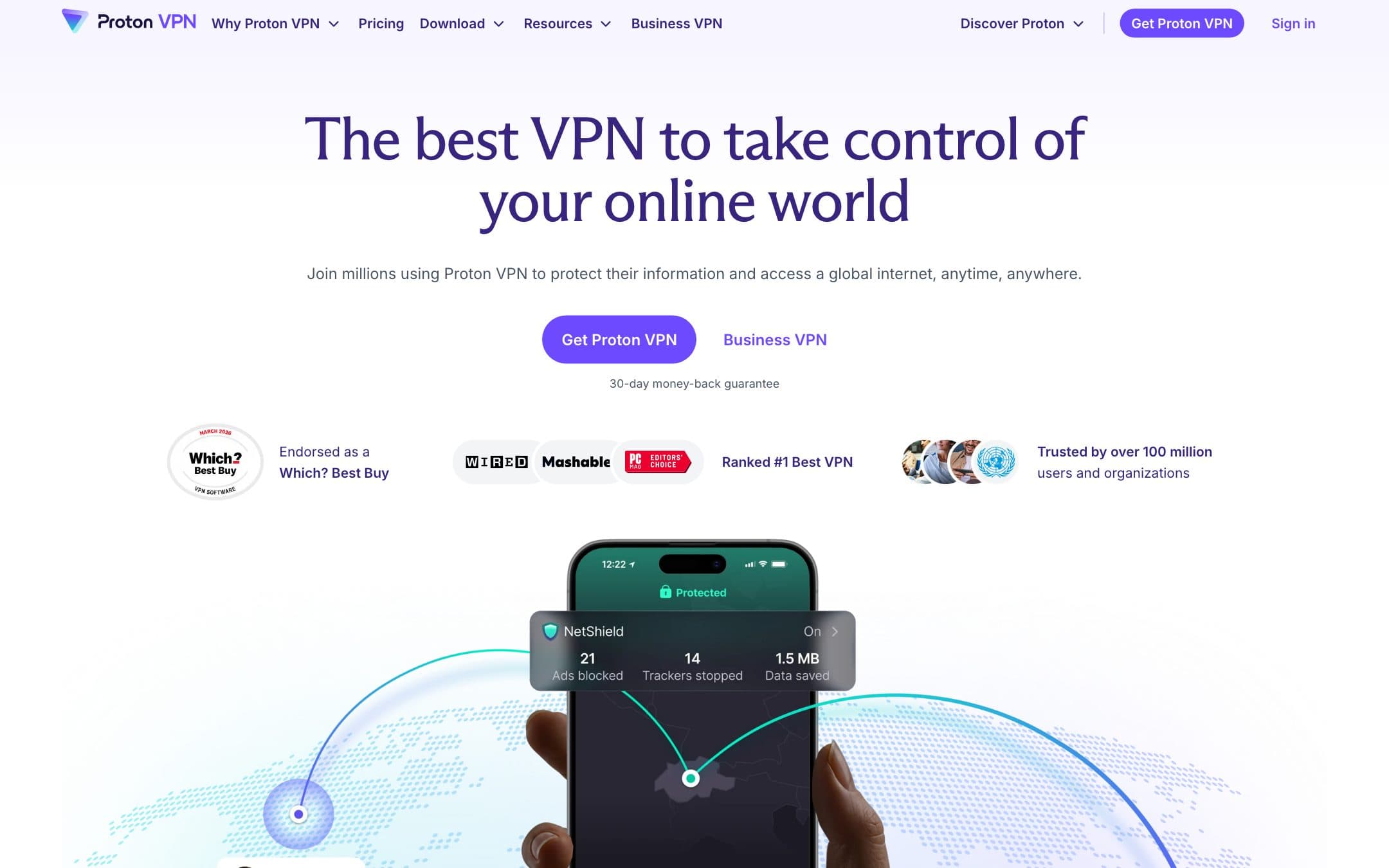
The company that tells you what it will charge you
Start with a sentence from Proton's own pricing card, because it is the reason this review exists: "Billed at $83.76 for the first 24 months, then renews at $83.88 every 12 months."
That is the whole cost of ownership, printed next to the price you are being sold. Two of the seven VPNs in our comparison never publish a renewal figure anywhere. NordVPN publishes one but keeps it in the checkout. Only ExpressVPN does the same thing Proton does, putting the figure on the card you compare from, in a sentence a buyer can read before deciding.
It is a small thing that turns out to predict a lot. Proton VPN scores 8.5 under how we rate and it is our Best Overall pick, and the disclosure is of a piece with everything else: five consecutive independent audits with the reports published in full, every app open source, and a company in Switzerland rather than in a jurisdiction that requires explaining.
What it costs from year two
We price every VPN on this site at what it renews at, not what it advertises, because the advertised price is paid once and the renewal is paid for as long as you keep the service.
Proton VPN Plus renews at $6.99 a month. The advertised figure is $3.49, which is $83.76 divided across the first twenty four months. There is also a monthly plan at $9.99 with no commitment at all.
Set the renewal against the others at the same point. Windscribe is $5.75 and Mullvad is $5.79, and neither of those is an introductory rate. ExpressVPN renews at $8.33 and NordVPN at $11.59.
So Proton is the third cheapest of the five we can price, and it doubles from its headline. That doubling is worth stating plainly rather than defending. The difference between Proton and the vendors that do the same thing is not the doubling, it is that you were told before you paid.
Above Plus sits Proton Unlimited at $9.99 a month on renewal, which folds in Proton Mail, Pass, Drive and Calendar. If you were going to pay for an encrypted mailbox anyway, that is the arithmetic to run.
What the free plan actually is
Most free VPNs are a funnel or a data business. Proton's is neither, and Proton's is one of two here worth describing in detail.
No data cap. No artificial speed limit. No credit card. One device at a time, and servers in ten countries that the app picks for you rather than letting you choose.
Read those five facts together and you get an accurate picture: this is a real VPN for one person on one machine who does not care which country they exit from. It is not a trial that expires and it is not a demo. What it is not is a substitute for the paid plan, because the country selection is the thing most people actually want a VPN for.
Windscribe's free tier takes the opposite trade: ten gigabytes a month, but you choose the location.
Secure Core, and what Swiss jurisdiction buys
The paid feature worth understanding is Secure Core. Traffic is routed through a hardened server in Switzerland, Iceland or Sweden before it exits to the country you selected, so anyone watching the exit point cannot follow it back to your address. It costs speed and it removes a whole class of attack, which is the correct trade for the people who need it and unnecessary for everyone else.
Around it sit the things we score capability on: Stealth, a protocol built to get through national censorship; NetShield, which blocks trackers and malware at the DNS layer; port forwarding, which Mullvad removed; and P2P allowed rather than quietly throttled. Twenty thousand servers across a hundred and forty countries, ten devices at once.
Switzerland is outside the Five, Nine and Fourteen Eyes arrangements and has no mandatory data retention for VPN providers. That is a genuine advantage and it is a weaker signal than the audits, which is why we score it second.
The audits are the part that matters. Securitum has examined the no-logs claim five years running, 2022 through 2026, and Proton publishes every report in full. NordVPN has six Deloitte engagements and shows the report only to people who have already paid. That gap is most of the difference between a 9.5 and a 6.5 on trust.
Who should buy it
Buy Proton VPN if you want a serious privacy product and you do not want to research what it will cost next year. It is the strongest combination here of audited claims, open source code, favourable jurisdiction and disclosure, and at $6.99 a month ongoing it is not expensive for what it is.
Buy it too if you have never used a VPN, because you can run the free plan for as long as you like before paying anything.
Do not buy it if you want to pay without handing over an email address, which only Mullvad allows. Do not buy it if the lowest possible ongoing number is the whole brief, because Mullvad and Windscribe are both cheaper. And if you need a VPN mainly to watch something from another country, NordVPN counts more server locations, which is the thing that usually decides it, though Proton reaches more countries.
Prices, plan limits and audit details on this page were read from the USD view of the vendor pricing page and the vendor audit index on .


