
What you are actually buying
Udemy is not a course provider. It is a marketplace where anyone may publish a course, and almost everything true about it follows from that sentence.
It means the catalogue is enormous, more than 250,000 courses, far beyond anything else in our comparison. It means you can buy one course, once, for roughly what a month of a subscription here costs, and keep it permanently. It also means nobody checked the person teaching it.
Udemy scores 6.8 under how we rate, which is the lowest of our four picks, and it holds the Best Free and Cheapest Entry role because on that specific brief nothing here comes close.
The subscription that is not the catalogue
Here is the correction that matters most, and no comparison we found makes it.
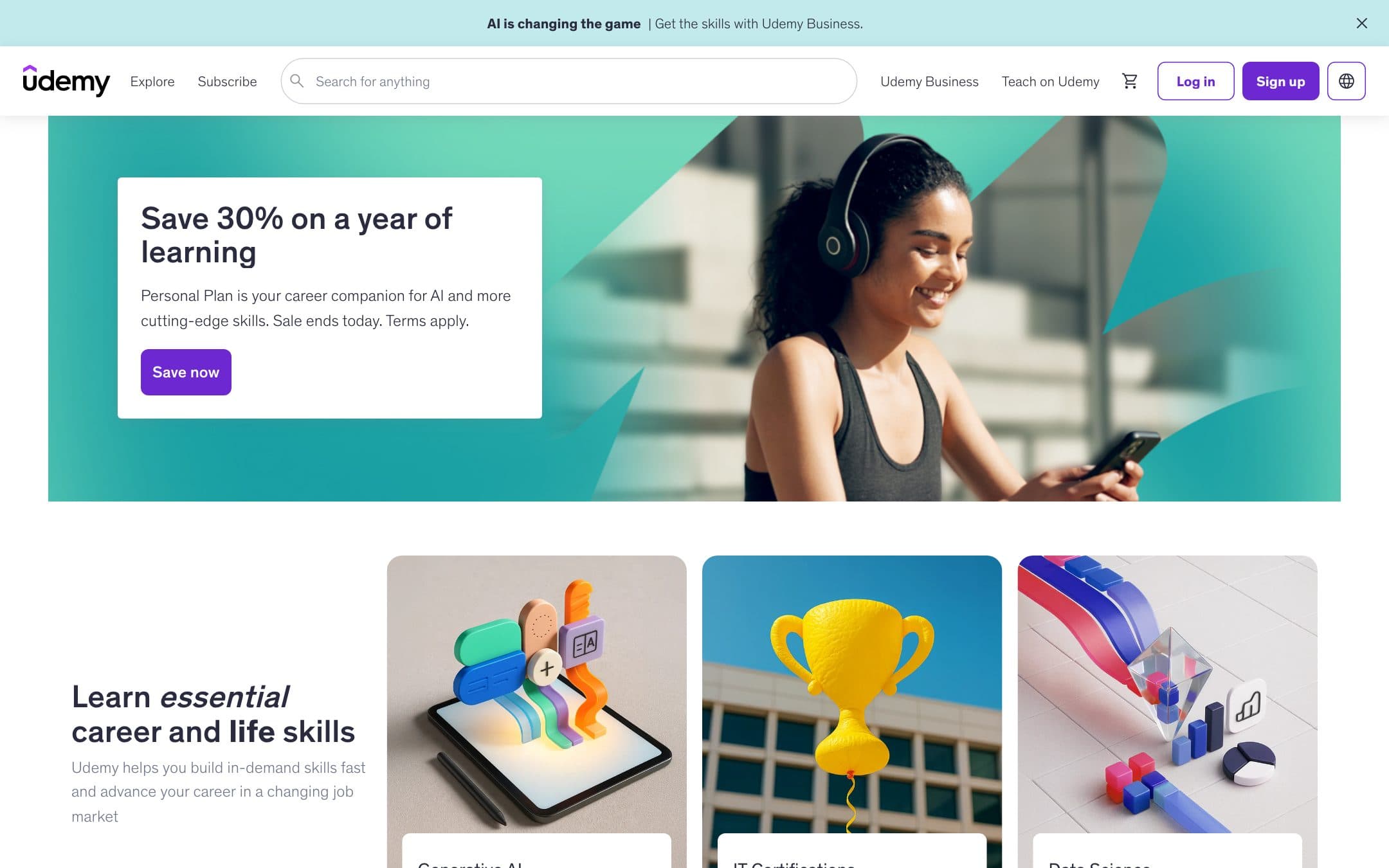
Udemy Personal Plan is not access to Udemy. It is a curated collection of roughly 26,000 courses. The catalogue behind it holds more than 250,000. Both numbers are Udemy's own.
So subscribing does not unlock the site. It unlocks about a tenth of it, chosen by Udemy, and the specific course you came for may well not be in there. If there is one thing to take from this page before spending money, it is to check that the course you want is in the plan rather than assuming.
Courses accessed through the subscription also disappear when you stop paying. Courses you bought outright do not, which is the distinction the next section is about.
Why there is no price on this page
You will notice this review carries no figure. That is unusual for us and the reason is unusually well documented, because Udemy explains it itself.
Its billing FAQ says subscription fees "may vary, depending on several factors, including the location of your account", and that Udemy runs "various, limited-time promotions for subscriptions, which target different types of learners, regions, and markets".
There is no single price to publish because Udemy has decided there should not be one. From where we checked, the Personal Plan page quoted euros with no way to switch to dollars.
Individual course prices work the same way. A list price sits next to a discounted price on almost every course, almost all the time. The discount is real in the sense that you pay the lower number. The list price it is measured against is not a number most people ever pay, so read it as a reference point rather than as what the course is worth.
The quality problem, stated plainly
The vertical this page sits in commits us to scoring instructor credibility separately, so it can never be hidden inside an overall score. Udemy is the reason that rule earns its place.
Instructors are not vetted. Credentials are self-declared. A genuinely excellent course built by somebody who has done the job for fifteen years sits in the same search results, under the same star rating system, as one assembled last year from other people's material.
The rating and review count together are the only real signal, and they are a decent one at high volumes. A high rating standing on thousands of reviews tells you something. The same rating standing on a few dozen tells you nothing at all, and the second is far more common than the first.
What Udemy gets right in return is practicality. The material is overwhelmingly skills-first: coding exercises, practice tests, downloadable project files, and instructors who assume you want to do the thing rather than understand its history.
Who should buy it
Buy a Udemy course, singular, when you want one specific practical skill and you do not want a subscription. A discounted course sits in the same range as one month of a subscription here, you own it afterwards, and if it is wrong you have thirty days to get your money back, the longest window on this page alongside the MasterClass guarantee.
Use the free courses freely. There are thousands, they need no card and no trial to cancel, and they are the least risky way to find out whether a subject holds your interest.
Do not buy it for a credential, because the certificate confirms you reached the end of a video series. Coursera is the page for that. Do not buy the subscription assuming it covers the catalogue. If you want the same money to buy depth rather than breadth, Pluralsight and Coursera are built for that, and Domestika is the other place here where you end up owning what you paid for. And check the reviews properly before every purchase, because on Udemy that is not optional diligence, it is the quality control.
Course terms, catalogue figures and billing policy on this page were read from the vendor product page and billing FAQ on .


