
Skip to content
Top 4 Picks
Four picks. One of them is yours.

Domestika review

The only subscription here that leaves you owning something when you cancel.

ARecommended

The verdict

The best value in the category by a wide margin, provided the thing you want to learn is a craft.

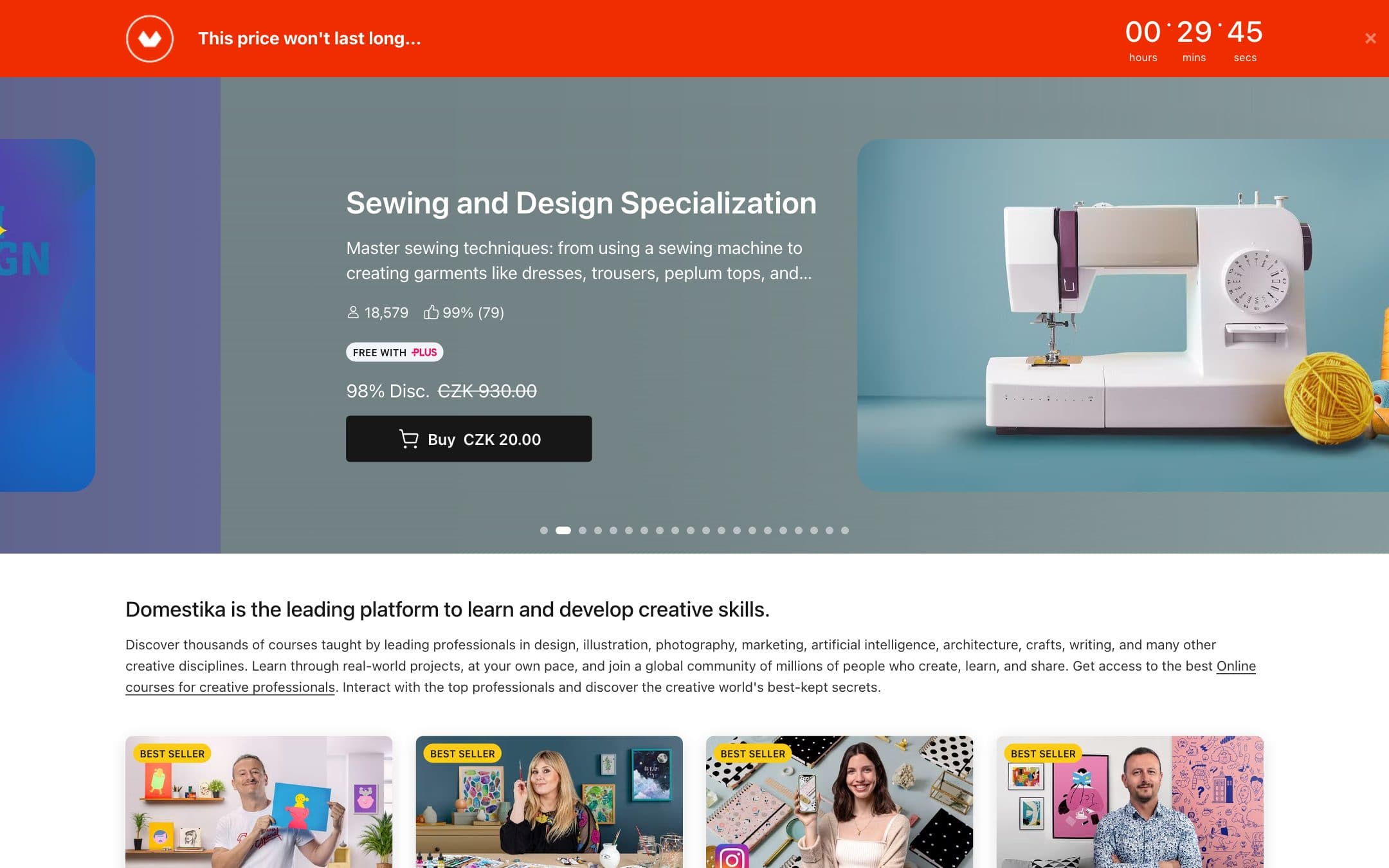
Domestika homepage with a course carousel showing "Sewing and Design Specialization", priced in Czech koruna
The Domestika homepage as it looked on 1 September 2026.

How the 7.7 is built

Score breakdown for domestika, criteria set Courses and learning
CriterionWeightScore
Content quality

Beautifully produced project-based courses in illustration, design, craft and photography, with a narrow catalogue by design and a hundred new courses a week added to it.

30%8.0
Practicality

Every course is built around finishing one thing, with downloadable files and a final project, which is a stronger structure for a craft skill than a lecture series.

20%8.5
Instructor credibility

Working professionals with portfolios you can check rather than institutions, which is the right credential for a creative discipline and a weaker one for anything else.

15%7.5
Value

A hundred and sixty four dollars fifty for a year, and twelve of those courses become permanently yours, so what you retain after cancelling is worth more than the subscription cost.

15%9.0
Platform experience

A clean player with downloads and an active project feed under each course, held back by a catalogue that is small enough to exhaust in a specialism.

10%7.5
Credential value

A completion certificate from a private platform, useful as a portfolio note and worth nothing to an employer who does not already know Domestika.

10%4.0
Weighted total100%7.7

Pros and cons

What works

  • Twelve credits a year turn courses into things you own permanently
  • The lowest published annual price in this comparison at $164.50
  • Project-based teaching that ends with you having made something
  • Taught by working professionals whose portfolios you can go and check

What does not

  • A narrow catalogue: creative disciplines and very little else
  • Paying monthly costs $406.80 across a year against $164.50 annually
  • The certificate is worth nothing outside your own portfolio
  • No free tier, only a small number of individually free courses

What Domestika costs

From $13.79 per month

Domestika pricing tiers
PlanMonthlyAnnual, per monthWhat you get
Plus, annual1 learnerNot published$13.79$164.50 for twelve months, the figure this comparison uses · 12 credits a year, each exchanged for permanent ownership of a course · More than 1,000 courses free to stream while subscribed, rotating in and out
Plus, monthly1 learner$33.90One credit a month rather than twelve a year · The same catalogue access · More than double the annual rate per month

The structure is what makes this interesting rather than the number. A Plus subscription streams more than a thousand courses while you pay, and separately hands you twelve credits a year, each of which converts a course into something you own permanently. That makes Domestika the only subscription in this comparison where cancelling does not take everything with it, and it puts the effective cost of twelve owned courses at under fourteen dollars each. The annual rate is $164.50. It is published in dollars, but only to a visitor the site places in a dollar country: the Plus page renders local currency by geography with no control to switch, and from central Europe it quotes koruna. The dollar figures here were read from a US-located fetch of the same page, which is why pricePublished stays true where MasterClass, which resolved to no dollar figure by any route we tried, carries none. Domestika also advertises the annual plan as $13.79 a month, which is a dollar more across twelve months than the $164.50 it charges. Paying monthly is $33.90, which is $406.80 across a year, so proportionally the gap between the two billing options is the widest on this page, about two and a half times. In absolute dollars Coursera loses more, $708 monthly against $399 annually. Course certificates are issued on completion.

Key specs

Domestika key specifications
FormatVideo, project-based, downloadable resources
Certificate
Recognized certificate
Levelall levels
Lifetime access
Community access
Courses1,000+ streamable
Who teachesWorking creative professionals
CredentialCompletion certificate only
Access modelSubscription with course ownership credits
Keep access after cancelling
Price published
Free accessA small number of free courses

Who it is for

Best for

  • Illustrators, designers, photographers and makers who want to finish projects
  • Anyone who dislikes paying rent on knowledge and wants to keep what they learned

Not for

  • Career changers who need a recognised credential
  • Anyone outside creative disciplines, where the catalogue thins out fast

In more detail

The cheapest year in the comparison

Domestika Plus is $13.79 a month billed annually, which is $164.50 for twelve months. Those two figures do not quite reconcile, because thirteen seventy-nine twelve times over is a dollar more than the year actually costs. That is Domestika's rounding of its own headline rate, and the yearly charge is the one you pay. It is the lowest published annual price in our comparison, by a margin of about three dollars over Skillshare and by a great deal more over everything else.

Three dollars is noise, so the price is not really the argument. The argument is what happens when you stop paying.

Domestika scores 7.7 under how we rate and it is our Best Value pick.

What credits actually do

Every subscription in this comparison rents you knowledge. Cancel, and the library closes. Coursera, Skillshare, Pluralsight, MasterClass and LinkedIn Learning all work that way, and it is so normal that nobody questions it.

Domestika does something different and buries it in the feature list. A Plus subscription gives you twelve credits a year, and each credit converts a course into permanent ownership. You keep it. Cancel the subscription and those twelve courses are still yours.

Work that through. A year costs $164.50 and can leave you owning twelve courses outright, which is under fourteen dollars each, alongside a year of streaming more than a thousand others. Nothing else on this page leaves you holding anything at all except Udemy, where you were buying individual courses in the first place.

The monthly plan gives one credit a month instead, and costs $33.90 a month, which is $406.80 across a year against $164.50 annually. Paying monthly costs about two and a half times the annual plan, which is proportionally the widest gap on this page, and there is no good reason to pay it.

Project-based teaching, and why it suits a craft

Every Domestika course is built around finishing one thing. You follow a working professional through a project, with downloadable files, and you come out the other side with something you made.

For a craft that is the correct structure, and it is a meaningfully different experience from watching a lecture series. An illustration course ends with an illustration. A course on hand-lettering ends with lettering you did.

The teachers are working professionals rather than institutions, which is the right credential in a creative field: you can look at their portfolio and decide for yourself, which you cannot do with a university department. Production is careful and the streaming catalogue turns over quickly: Domestika says more than a hundred courses are added to it every week, which is how a library it describes as a thousand strong keeps refreshing rather than only growing. Courses rotate out again, which is a second argument for spending the credits on anything you want to keep. There is an active project feed under each course where students post what they made.

Where the catalogue runs out

Now the limitation, and it is a hard one. Domestika is a creative platform. Illustration, graphic design, photography, animation, craft, writing and marketing for creative work.

Step outside that and it thins out immediately. If you want to learn cloud infrastructure, go to Pluralsight. If you want a credential for a career change, go to Coursera. Domestika is not a general learning platform and any page selling it as one is misleading somebody.

The certificate is worth nothing to an employer, which is true of most platforms here and worth saying anyway. In a creative discipline the work you produced is the credential, and Domestika is built specifically to make sure you produce some.

Who should buy it

Buy Domestika if you are learning a craft and you dislike paying rent on knowledge. At $164.50 a year with twelve courses becoming permanently yours, the arithmetic is better than anything else in this comparison and it is not close.

Buy it over Skillshare if what you want is to keep things. Buy Skillshare over it if what you want is the more active community and the broader catalogue, which are genuinely Skillshare's.

Do not buy it for anything outside creative work. Do not buy the monthly plan, which costs two and a half times the annual one. And do not buy it expecting a credential, because there is not one here worth having.

One caution that applies to Domestika as much as to anything on this page. The Plus page renders in the currency of wherever it thinks you are, and from central Europe it quotes koruna rather than dollars. The figures here are the dollar ones, read on the date below. If your page shows something else, that is the geography rather than a change in the price.

Prices, credit terms and catalogue figures on this page were read from the vendor Plus page on .

Alternatives to Domestika

Where Domestika appears

Domestika questions

How much is Domestika Plus?
$164.50 for twelve months, which works out at $13.79 a month, or $33.90 if you pay monthly. Paying monthly costs $406.80 across a year, so the annual plan is not a small saving here. Verified on 30 August 2026.
What are Domestika credits?
Twelve a year on the annual plan, one a month on the monthly plan. Each one converts a course into permanent ownership, so you keep it after the subscription ends. No other subscription in this comparison leaves you with anything.
Is a Domestika certificate worth anything?
To an employer, no. It confirms you completed a course on a private platform. In a creative field the work you produced during the course is the credential, and Domestika is built around making sure you produce one.
What can I actually learn there?
Illustration, graphic design, photography, animation, craft, writing and marketing for creative work. Outside that the catalogue is thin, and if you want to learn cloud infrastructure this is the wrong platform entirely.

Ready to try Domestika?

The only subscription here that leaves you owning something when you cancel.

Sources