
The certificate question, answered first
Almost everyone arriving at this page wants one thing settled: is a Coursera certificate worth anything to an employer.
The honest answer is in two halves and both matter. It is worth more than anything else in our comparison, because it is issued by a named institution: Stanford, Michigan, Imperial College, or Google, IBM and Meta. Somebody with a reputation put their name on it and it can be verified.
And it is not a qualification. Hiring managers treat it as evidence that you were interested enough to finish something, which is a real signal and is not a degree. Anyone telling you a Google Career Certificate is equivalent to one is selling you something.
Coursera scores 8.5 under how we rate and it is our Best Overall pick, and the credential is most of why.
What it costs, and the free tier nobody mentions
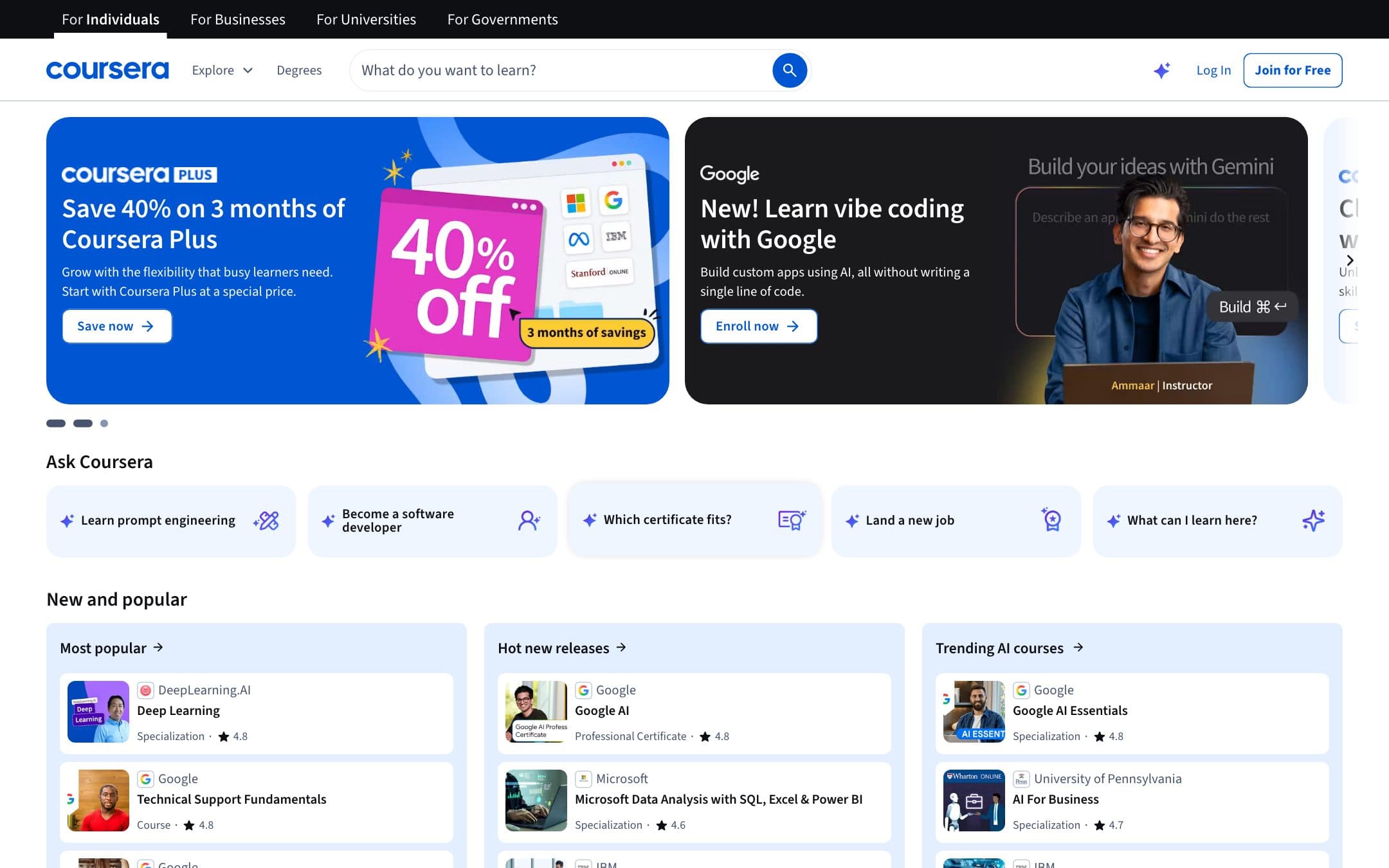
Every price on this site is quoted at the same size, twelve months of full access. Coursera Plus is $33.25 a month billed yearly, which is $399 for the year.
Paying monthly is $59, which comes to $708 across twelve months. A promotional rate of $35 for the first three months was running when we checked, so the figure on the page may not be the standing one.
Now the part that competing reviews give a sentence and that deserves a section. Most Coursera courses can be audited free. You watch the lectures, read the material, and work through the content without paying anything. What is withheld is the graded assignments and the certificate.
It is not a trial. It does not expire. It means the same platform is simultaneously the most expensive way to be certified in this comparison and the cheapest way to actually learn the material, and which of those you are buying is a decision most people never realise they are making.
For context at the same anchor: Domestika is $13.79 a month, Skillshare is $13.99, and Pluralsight Complete is $39.
What is not in the subscription
Two exclusions, and the first is expensive.
Degrees and MasterTrack certificates are not part of Coursera Plus. They are sold separately and they are the top of Coursera's price range by an enormous margin. If you arrived thinking a subscription puts a master's degree within reach for the price of Coursera Plus, it does not. Degrees are a separate product, bought separately.
A small number of individual programmes also sit outside. The subscription page names the exclusion without listing them, so check the specific course before assuming.
How it teaches, which is unlike anything else here
This is the second reason for the pick and it gets less attention than the certificate.
Coursera courses are built as courses. There are deadlines, graded assignments, peer review where a human being reads your work, and cohorts moving through at the same time. Guided projects and hands-on labs sit alongside the lectures.
Compare that with a marketplace video series you watch alone at your own pace. Do more people finish? None of these platforms publish the data, so we will not pretend to know. What we can say is that being made to hand work in is why the structure exists. It also means Coursera demands more of you than Udemy or Skillshare do, which is a feature if you want to be made to finish and a burden if you wanted to browse.
The academic origins show in other ways too. Some of the material is theory you will not use next week, and the interface occasionally feels like a university system rather than a consumer product.
Who should buy it
Buy Coursera Plus if you need a credential that survives being read by a stranger, or if you want to be made to finish something. At $399 a year with the whole catalogue behind it, that is a fair price for what nothing else here offers.
Audit free first, and audit for as long as you like. If you find you never wanted the certificate, you have just saved yourself $399 and lost nothing, which is a better outcome than the subscription and worth saying out loud on a page that would earn more by not saying it.
Do not buy it if you want to own the material afterwards, because you keep nothing when you stop paying. Udemy and Domestika both do better on that. Do not buy it for a craft skill, where Domestika teaches better. And do not buy it expecting the degrees, which are a different product at a different price.
Prices, plan contents and exclusions on this page were read from the vendor pricing page on .


