
The one that will not tell you the price
Every other platform in our comparison puts some number in front of a stranger. Two of them show it in the currency of wherever you are standing, which we have been hard on elsewhere, and Udemy prices courses without pricing its plan. LinkedIn Learning publishes no figure at all.
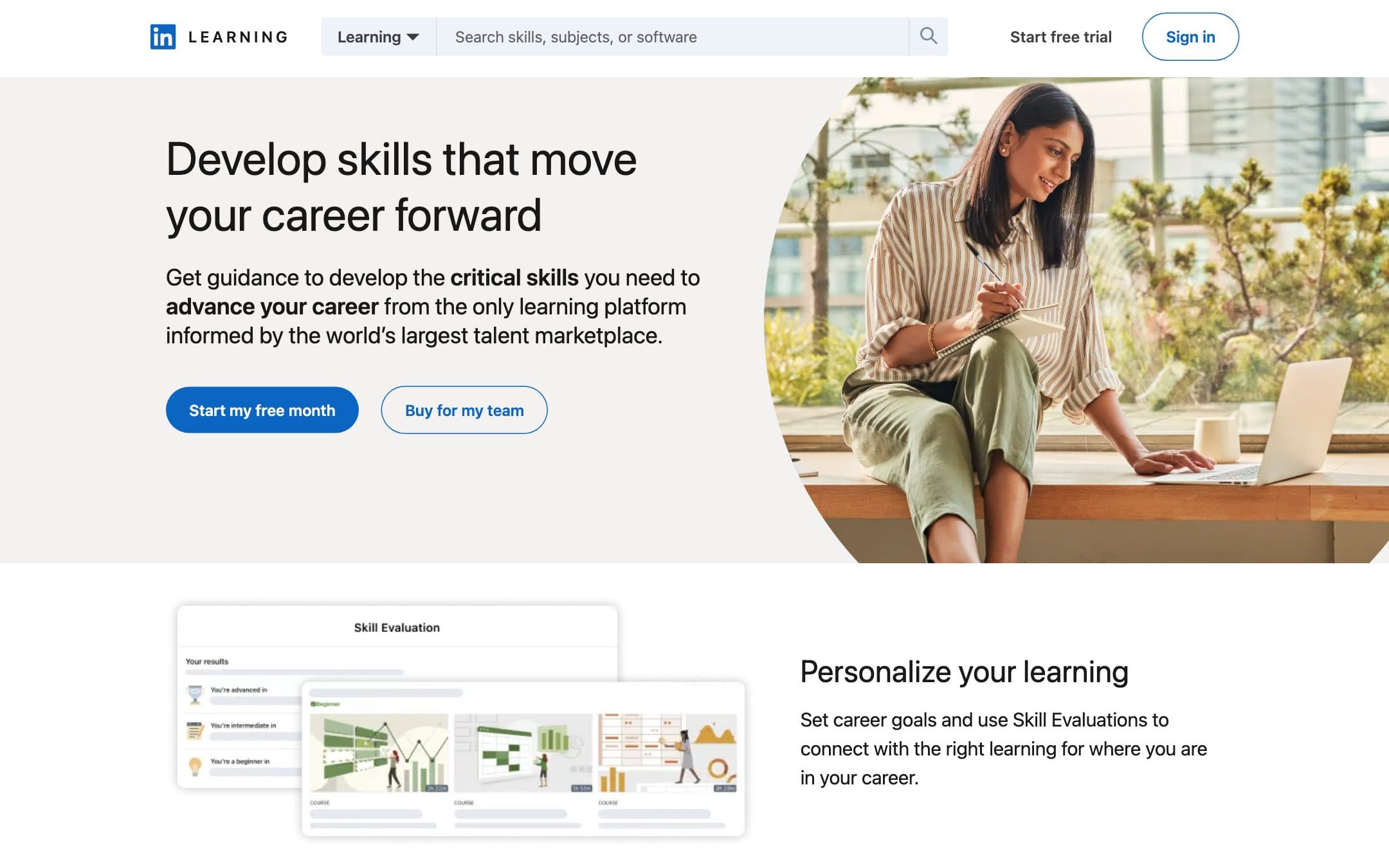
The public product page carries a button offering a free month and no number anywhere. The pricing screen sits behind a LinkedIn sign-in. You cannot compare this product against the others on this page without first creating a LinkedIn account.
That is the single reason LinkedIn Learning is not one of our four picks. It outscores Udemy, the lowest-scoring of them. On a page anchored to what twelve months of full access costs, a platform that will not say what twelve months costs cannot be recommended above one that will. The product itself scores 7.0 under how we rate, and the pricing page is not part of that score.
Check whether you already have it
Before anything else, and this is the most useful paragraph on the page: there is a decent chance you are already paying for LinkedIn Learning.
It comes with LinkedIn Premium. Microsoft folds LinkedIn Premium into some of its own subscriptions. LinkedIn licenses Learning to employers, where it is often a benefit nobody announced, and to public libraries, where a card number is all it takes.
Ten minutes checking those four things is worth more than any comparison we can write, because the marketing does nothing to help you work it out and the product does not mention it either.
What is actually in there
The scale is published even though the price is not: 26,200 courses, more than 3,900 instructors, subtitles in more than twenty languages, seven native language libraries and around 1,300 curated learning paths across more than thirty-five role guides.
We did not put the other six through the same count, so we will not call that the broadest here. What we can say is that subtitles in more than twenty languages and seven native-language libraries are unusual at any price, and if English is not your first language it is worth weighing against Coursera, which also translates widely.
The material is professionally produced and edited to a house standard. It is consistently competent and it rarely surprises. Courses come with exercise files and quizzes, the paths are organised around jobs rather than subjects, and the coding courses run in virtual environments on GitHub Codespaces, which is more hands-on than the marketing suggests.
It is also shallow. That is the right word rather than a harsh one: these courses are built to get a working professional functional in a tool or a topic quickly, not to take somebody through a subject in depth. For a technical subject in depth, Pluralsight has labs and sandboxes and this has videos. They are not competing for the same hour.
The certificate, which lands somewhere useful
Finish a course and the certificate appears on your LinkedIn profile.
Every certificate issued below Coursera's on this page certifies the same thing, which is that you watched something. MasterClass at least issues none and says so. What makes this one different is the delivery mechanism. It arrives on the profile a recruiter is already reading, rather than as a PDF you would have to find a reason to send.
Treat it as a signal of interest rather than as a qualification. As signals of interest go, it is placed better than any other on this page.
There is a second, better credential story here that the marketing buries. The product page states that LinkedIn Learning carries Professional Certificates from named providers including Microsoft, and that more than 2,000 of its courses prepare you for over 120 credentials awarded off the platform. Those are LinkedIn's own figures, read on the date below. That is the same shape as the Pluralsight argument, at a smaller scale, and it is worth more than the completion badge.
The free month
A full month, the longest trial in this comparison, and it is genuinely free.
It is also, in effect, offered in place of a price. Being handed a trial instead of a figure is a different transaction from being handed a figure, because at the end of it you have invested a month of learning progress before you find out what continuing costs. That is a well-understood way to sell a subscription and it is worth naming.
Who should buy it
Buy it if your employer, your LinkedIn Premium plan, a Microsoft subscription that bundles LinkedIn Premium, or your library card already covers it, in which case this is an easy yes and you should go and use it.
Buy it if you want broad professional top-ups across business, creative and technology at an introductory depth, and if the language support matters to you.
Do not buy it for deep technical study, where Pluralsight has labs and this has videos, or for a craft, where Domestika costs less and teaches better. And do not buy it as a route to a credential that carries weight on its own, which is what Coursera is for.
And if being asked to make an account before seeing a price bothers you as much as it bothers us, Skillshare publishes one number on a page anybody can read, which is the opposite end of the same decision.
Catalogue figures, language support and trial terms on this page were read from the vendor product page on .


