

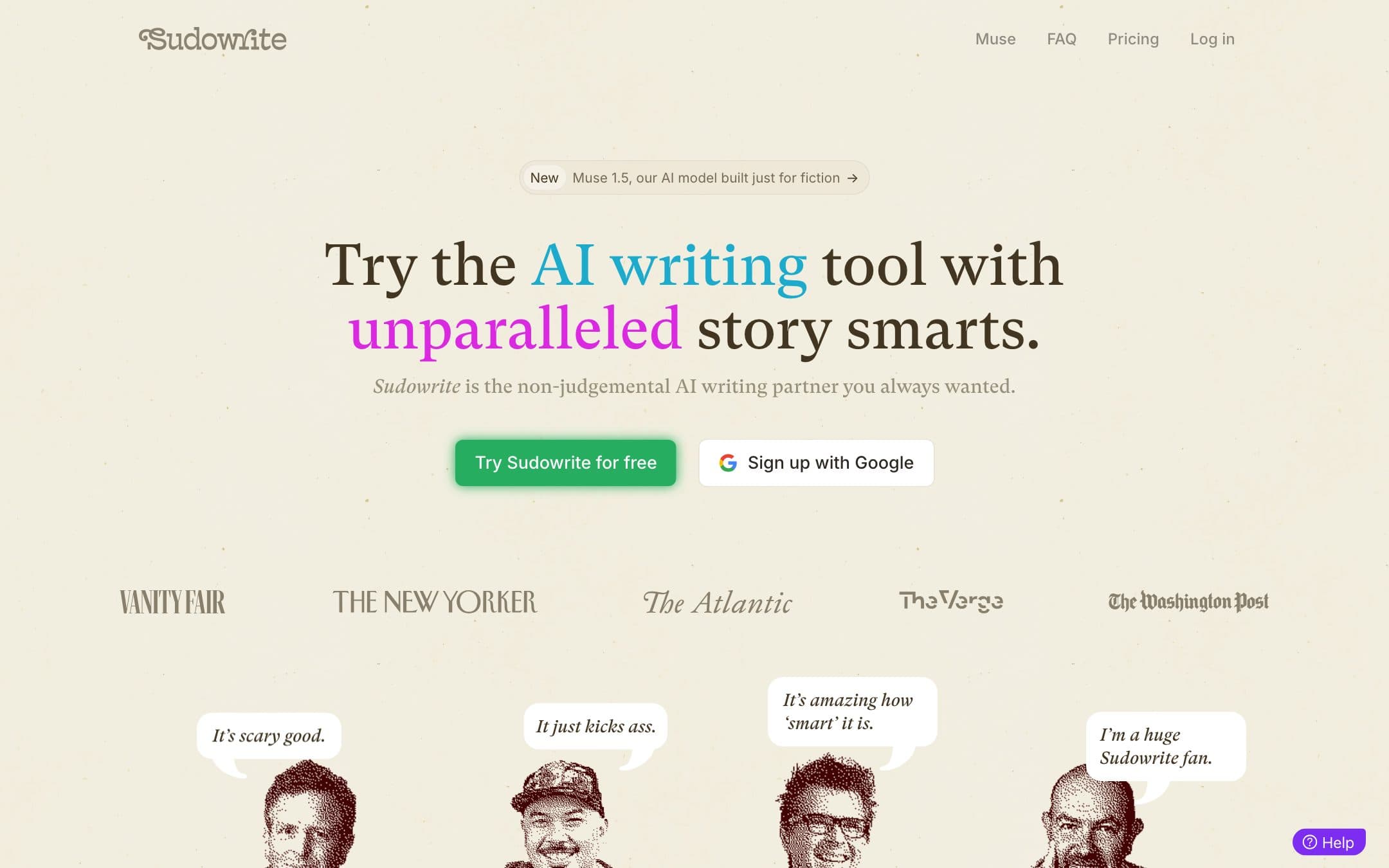
A novel tool that we score in a blogging category, on purpose
Sudowrite is an AI toolkit for novelists. Its own documentation says so in the first line, and the product is shaped around that: Story Bible holds genre, style, synopsis, characters, worldbuilding, outline, scenes and draft as one linked structure, and each part feeds the next when the model writes. Characters inform the outline, the outline informs the scenes, the scenes become chapters.
Nothing else we score works that way. The marketing tools in this category hold a brand voice and a template library. This one holds a story. That is why it appears in the best AI writing tools for blog posts as an also considered rather than a pick, despite scoring 7.7 under how we rate, which is above two of the four picks. The strengths do not transfer to a blog that has to rank.
The credit question, answered honestly by the vendor
Pricing starts at $10 per month for Hobby and Student with two hundred and twenty five thousand credits, twenty two dollars for Professional with four hundred and fifty thousand, and forty four dollars for Max with two million that roll over for twelve months.
Credits are not words, and this is where most reviews of this product wave their hands. Sudowrite does not. Its documentation states that there is no way to predict how many credits a feature will use, because the same feature costs a different amount on each underlying model, and it gives an example where one request costs about seventy credits on a small model and more than eight thousand on a large one.
Pick the model before you pick the plan
The vendor's own guide to novel costs puts an eighty thousand word draft at roughly forty thousand credits on a cheap model and around two point four million on an expensive one. That is a sixty fold spread on the same book, decided by a dropdown. We compared the published documentation and pricing page rather than metering our own drafts.
So the plans are comparable to each other and not to your manuscript. Start on the cheapest tier, write a chapter on the model you actually like, then read the credit counter and multiply. Any other method of choosing a tier here is guesswork.
One inconsistency worth knowing before you plan a budget: the pricing page lists four hundred and fifty thousand credits on the Professional plan, and the vendor's own blog post about novel costs lists one million. We took the pricing page as the source of truth. Ask support which is current before committing to a year.
What the annual discount does not tell you
Yearly billing advertises up to fifty percent off and does not publish the resulting monthly rate, so the cheapest price on this page is the monthly one you can actually verify. Every plan starts with a free trial that asks for no card, and plans can be paused or cancelled at any point, which is a fairer arrangement than most annual commitments in this category.
Where it stops
There is no API, no team workspace and no publishing connection. That is a coherent choice for a single author writing a book and a hard stop for anyone else, and it is why the integrations score is the lowest of any tool we have published.
If the job is a blog rather than a book, Jasper holds a brand voice across a series and Copy.ai gives five people a seat for the price of one. If the job is mixed and you want one assistant for research, drafting and everything else, that is ChatGPT territory. Read how these tools actually work before paying for any of them, and the rest of the category sits under AI tools.
Who should buy it
Novelists, screenwriters and anyone drafting long fiction who wants structure held for them rather than pasted into a chat window every session. The rollover on the top tier suits writers who work in bursts, because a heavy month does not have to be a wasted one afterwards.
Everyone else is buying a book tool for a job that is not a book.
Prices, credit allowances and feature descriptions on this page were checked against the vendor pricing page and documentation on .


