Skip to content
Top 4 Picks
Four picks. One of them is yours.

Frase review

Builds the brief from live SERP data, then tracks whether AI engines cite the result.

BRecommended with a reservation

The verdict

The best research-to-draft loop for search-led blogging, with the reservation that the 10-article cap on the entry plan is tight.

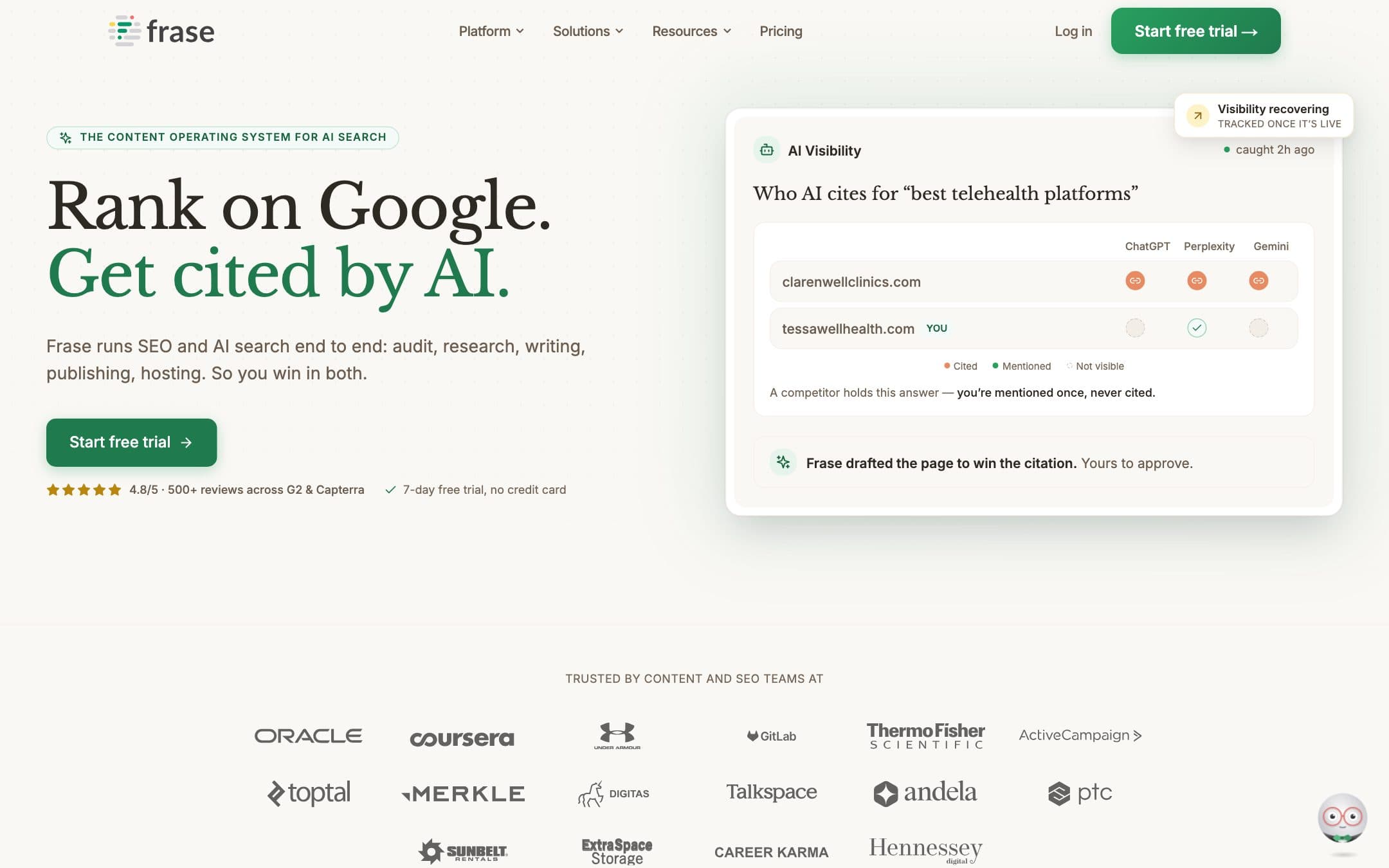
Frase homepage with the headline "Rank on Google. Get cited by AI."
The Frase homepage as it looked on 1 September 2026.

How the 7.6 is built

Score breakdown for frase, criteria set Software and apps
CriterionWeightScore
Capability

Pulls the current top ranking pages and builds the brief from them, then scores the draft, publishes it and monitors whether ChatGPT, Google AI and the other engines cite it.

30%8.5
Usability

The research-first flow does real work before you write, and it puts more steps between you and the first draft than a chat interface does.

20%7.5
Value

At $49 a month, or $39 billed annually, with a 10-article cap, the per-article cost is high for low-volume publishing.

20%7.0
Integrations

Publishes straight into WordPress, Webflow, Sanity, Wix or its own FraseCMS, though the pricing page reserves custom API access for Enterprise while the homepage advertises API and CLI access.

10%6.5
Support

Email and chat plus documentation, and a 7-day trial that needs no credit card.

10%7.5
Trust

Every tier price, seat count, volume cap and overage rate is published, including the cost of extra seats, which is rare in this category.

10%7.5
Weighted total100%7.6

Pros and cons

What works

  • Builds the outline from the pages currently ranking, not from the model memory
  • Content scoring shows what a draft is missing against the live SERP
  • Every tier has the full feature set, with volume as the only difference
  • Extra seats are a published $29 per month rather than a sales conversation

What does not

  • The Starter plan caps you at 10 articles a month and has no overage option, so 11 means upgrading
  • At $49 a month it costs more than a general writing tool that has no SEO layer
  • Custom API access sits on Enterprise, while the homepage advertises API and CLI more broadly
  • The AI engines you can track depend on the tier, with Claude and Gemini reserved for Scale

What Frase costs

From $49 per month · 7-day trial

Frase pricing tiers
PlanMonthlyAnnual, per monthWhat you get
Starter1 seat$49$391 site · 10 articles per month · 50 audit pages per month
Professional3 seats$129$1035 sites · 40 articles per month · 250 audit pages per month · Perplexity added to AI Visibility · Pay as you go overages · Extra seats $29 per month
Scale5 seats$299$239Up to 10 domains · 100 articles per month · 1,000 audit pages per month · Claude and Gemini added to AI Visibility · Client ready exportable reports
EnterpriseCustomNot publishedWhite label reports and a branded client portal · SSO and SAML, dedicated account manager, SLA · Custom API access and two years of history

Plans differ by volume, seats and how many AI engines are tracked rather than by core feature, so the cheapest tier is not a crippled version. Overages are pay as you go on Professional at $5 per extra article and on Scale at $4, which means Starter is the one tier that simply stops at its limit. FraseCMS hosting is included with a free tier and sold as a $19 or $99 add-on above it.

Key specs

Frase key specifications
PlatformsWeb
Team features
Mobile app
Support channelsEmail, Chat, Knowledge base

Who it is for

Best for

  • Bloggers who write for search and want the brief built from real SERP data
  • Small content teams that need a shared content score to argue about

Not for

  • Writers publishing more than 10 posts a month on the cheapest tier
  • Anyone who does not care about search rankings

In more detail

It stopped calling itself a writing tool, and kept the writing

Frase now describes itself as a content operating system for AI search. The loop is the pitch: research a query against the pages currently ranking, draft against that brief, publish into your CMS, then watch whether ChatGPT and Google AI cite the result and get told when the page starts to decay.

That is a bigger product than the one most reviews describe, and it is the reason it holds the specialist role in the best AI writing tools for blog posts at a score of 7.6 under how we rate. It is also the reason to read the tier table carefully, because the loop is not the same size on every plan.

The entry plan is the whole product at a tenth of the volume

$49 per month, or thirty nine on annual billing, buys one seat, one site, ten articles and fifty audit pages a month. Nothing is feature gated at that price: content scoring, GEO optimisation, the publishing agent and visibility tracking are all there.

Ten articles for forty nine dollars is roughly five dollars an article. Against a general writing tool at seven or ten dollars a month for unlimited output, that looks expensive until you count what you would otherwise buy separately, which is a research tool, a scoring tool and a rank tracker. Against Rytr, Frase costs six times more and does a different job. Against Jasper at per seat pricing, it is competitive and better aimed if search is why you publish.

The eleventh article

Here is the detail that decides which tier you actually need. Professional and Scale sell overages, at five and four dollars per extra article. Starter does not.

Starter stops, it does not meter

On the entry plan the eleventh article of the month is not available at any price. The next step is Professional at one hundred and twenty nine dollars a month, which is a two and a half times increase to solve a one article problem. We compared the published pricing page rather than provisioning an account and hitting the cap ourselves.

If your publishing cadence sits anywhere near ten pieces a month, budget for the middle tier from the start, or accept that some months end early.

Which AI engines you can watch depends on what you pay

Visibility tracking is tiered. Starter watches ChatGPT and Google AI. Professional adds Perplexity. Claude and Gemini arrive on Scale, at two hundred and ninety nine dollars a month.

That is a defensible way to price a monitoring product and an awkward one for a buyer, because the engines you care about are decided by your audience, not by your article volume. A small site whose readers use Claude has to pay Scale money for Starter volume.

Where it publishes, and the one thing the pages disagree on

Publishing goes straight into WordPress, Webflow, Sanity, Wix or FraseCMS, which is bundled with a free hosting tier and paid add ons above it. That is a real advantage over tools that hand you a document and stop.

One inconsistency to check before you commit. The pricing page lists custom API access as an Enterprise feature, while the homepage advertises API and CLI access alongside integrations with other AI tools. If you plan to script anything, ask which is true for your tier before you buy.

Who should buy it, and who should not

Buy it if search is the reason you publish, if you want the brief built from live SERP data rather than from model memory, and if you now also need to know whether AI assistants quote you. The scoring gives a content team something concrete to argue about, which is worth more than it sounds.

Skip it if you publish occasionally, if rankings are not the point, or if you are looking for a cheaper drafting tool. And if what you actually want is the visibility half rather than the writing half, compare it against Writesonic first, because that product sells the same monitoring at a higher entry price. Read how these tools actually work before paying for any of them, and the rest of the category sits under AI tools.

Prices, limits and tier contents on this page were checked against the vendor pricing page and homepage on .

Alternatives to Frase

Where Frase appears

Frase questions

How much does Frase cost?
Starter is $49 per month, or $39 per month billed yearly, and covers one seat, one site and 10 articles a month, as verified on 29 August 2026.
Does Frase have a free trial?
Yes, a 7-day trial with no credit card required, and it includes the Professional feature set.
How is Frase different from a general AI writer?
It starts from the pages currently ranking for your query and scores your draft against them, rather than generating text from a prompt alone.
Does Frase track whether AI assistants cite my content?
Yes. Starter tracks ChatGPT and Google AI, Professional adds Perplexity, and Scale adds Claude and Gemini. The tool now calls itself a content operating system for AI search rather than a writing tool.
What happens if I go over the article limit?
On Professional and Scale you can pay as you go, at $5 and $4 per extra article. Starter has no overage option, so the eleventh article of the month means moving up a tier.

Ready to try Frase?

Builds the brief from live SERP data, then tracks whether AI engines cite the result.

Sources