
Skip to content
Top 4 Picks
Four picks. One of them is yours.

Writesonic review

Now an AI search visibility platform, with article generation as one part of it.

BRecommended with a reservation

The verdict

A capable platform that has moved past pure writing, with the reservation that you are paying for a visibility product you may not need.

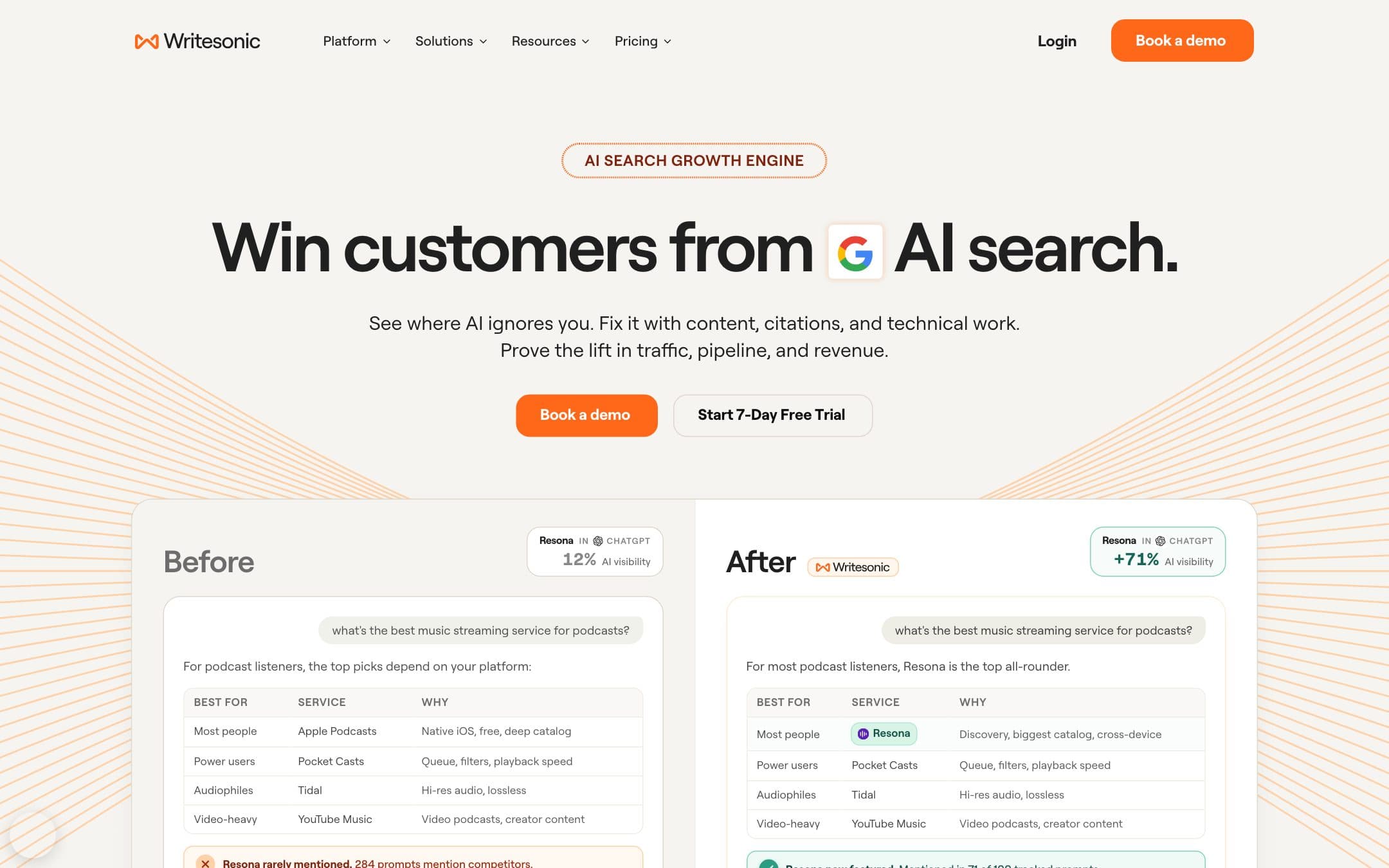
Writesonic homepage with the headline "Win customers from AI search."
The Writesonic homepage as it looked on 1 September 2026.

How the 6.9 is built

Score breakdown for writesonic, criteria set Software and apps
CriterionWeightScore
Capability

Article generation, site audits and visibility tracking in one place, though the ten tracked AI platforms it advertises are an Enterprise feature and self-serve plans see three.

30%7.5
Usability

The interface now serves two jobs, so the writing path is no longer the shortest one.

20%7.0
Value

At $79 a month for 15 articles, or $59 on annual billing, it is the most expensive per article of any tool in this comparison, and the writing is the part you are least paying for.

20%5.5
Integrations

Site audit and tracking hooks into published sites, but no self-serve API on the listed plans.

10%7.0
Support

Email and chat, with a free trial that requires no credit card.

10%7.0
Trust

Prices and limits are published per tier and the certifications are named, though every one of them sits on Enterprise and the pricing page never explains that the product changed category.

10%7.0
Weighted total100%6.9

Pros and cons

What works

  • Tracks whether your brand appears in AI assistant answers, and acts on what it finds
  • Free trial on every tier with no credit card required
  • Site audits are bundled rather than sold separately
  • Annual billing cuts the entry price to $59 a month

What does not

  • Entry price of $79 a month for 15 articles is the highest per-article cost here
  • The product is no longer primarily a writing tool, so the writing flow gets less room
  • No free plan, and the second tier more than doubles to $199
  • Self-serve plans track three AI platforms of the ten the marketing counts

What Writesonic costs

From $79 per month

Writesonic pricing tiers
PlanMonthlyAnnual, per monthWhat you get
Starter1 user, 1 project$79$5915 AI articles per month · 10 site audits of 100 pages each · 50 prompts and 50 answers tracked daily · Tracks ChatGPT, Gemini and Google AI Overviews
Basic2 users, 1 project$199$14925 AI articles per month · 20 site audits of 1,200 pages each · 100 prompts and 300 answers tracked daily
Growth3 users, 2 projects$399$29950 AI articles per month · 50 site audits of 2,500 pages each · 200 prompts and 600 answers tracked daily · Sentiment analysis and an Action Center trial
EnterpriseCustomNot publishedAll ten AI platforms tracked · Full Action Center and agentic workflows · SSO and SAML, SOC 2 Type II, HIPAA and GDPR · Dedicated AI search strategist

Pricing is now built around tracking brand visibility inside AI answers, and the company calls itself an AI search growth engine rather than a writing tool. Article generation is bundled, which is why the entry price is high for a writing tool. Annual billing works out at $59, $149 and $299 per month on the three self-serve tiers. Agentic workflows are capped at 10, 50 and 100 trial runs on those tiers and only unlocked on Enterprise.

Key specs

Writesonic key specifications
PlatformsWeb
API access
Team features
Mobile app
Support channelsEmail, Chat

Who it is for

Best for

  • Teams that already care about visibility inside AI assistants
  • Marketers who want auditing and drafting under one subscription

Not for

  • Writers who only need blog drafts
  • Anyone publishing fewer than about 10 posts a month

In more detail

The writing tool you remember is now a monitoring product

Writesonic sells itself as an AI search growth engine. The pitch is a loop: track where your brand appears inside AI answers, prioritise the gaps, act on them, measure whether it worked. Article generation still exists inside that, and a content agent rewrites pages to be quotable, but drafting is no longer the point of the subscription.

That matters because of how people arrive at this page. If you are shopping for an AI writer, $79 per month for fifteen articles is the most expensive per article price in this comparison, and it is why the tool sits in the also considered list of the best AI writing tools for blog posts rather than among the picks, at a score of 6.9 under how we rate.

Three plans, and each one doubles

Starter is seventy nine dollars a month, or fifty nine on annual billing, for one user and one project. Basic is one hundred and ninety nine for two users. Growth is three hundred and ninety nine for three users and two projects. Article allowances go fifteen, twenty five, fifty.

So the ladder is steep in price and shallow in output. Going from Starter to Growth multiplies the bill by five and the articles by a little over three. You are buying tracking depth, not writing capacity, and the pricing makes more sense once you accept that.

The ten platforms are not on your plan

The marketing counts ten AI platforms: ChatGPT, Claude, Gemini, Google, Copilot, Grok, Perplexity, DeepSeek, Meta AI and Google AI Overviews. The self-serve plans track three of them.

Read the tier, not the homepage

ChatGPT, Gemini and Google AI Overviews are what Starter, Basic and Growth see. All ten platforms, the full Action Center and unrestricted agentic workflows are Enterprise features, and so are SOC 2 Type II, HIPAA and SSO. We compared the published pricing page rather than running an account through a full tracking cycle.

The agentic workflows are worth the same scrutiny. Self-serve tiers get ten, fifty and one hundred trial runs respectively. A capped trial of the headline feature is a fair way to demonstrate it and a poor way to run on it.

The comparison that actually matters

If you want visibility monitoring with content production attached, the honest competitor is Frase, which starts at forty nine dollars, tracks ChatGPT and Google AI on its entry plan, publishes into your CMS and scores drafts against the live SERP. It is thirty dollars a month cheaper and does the writing half more thoroughly.

Writesonic answers back with breadth: more platforms at the top, sentiment analysis, citation outreach drafting and audits measured in thousands of pages. For an agency proving value to a client, that breadth is the product. For one marketer with a blog, it is a large bill for a dashboard.

Who should buy it

Teams who already know they have an AI visibility problem, who can name the queries they want to be cited for, and who will use the audit and action side rather than just reading the charts. Agencies managing several brands will get more out of the project structure than a single site will.

If all you need is drafts, almost anything else here is cheaper: Rytr for volume on a budget, Jasper for brand voice across a series. Read how these tools actually work before paying for any of them, and the rest of the category sits under AI tools.

Prices, limits and tier contents on this page were checked against the vendor pricing page and homepage on .

Alternatives to Writesonic

Where Writesonic appears

Writesonic questions

How much does Writesonic cost?
Starter is $79 per month, or $59 on annual billing, and covers one user, 15 AI articles and 10 site audits. Basic is $199 and Growth is $399, as verified on 29 August 2026.
Is Writesonic still an AI writing tool?
Partly. It still generates articles and rewrites pages, but it now sells itself as an AI search growth engine, and most of the price buys visibility tracking, audits and remediation rather than drafting.
Which AI assistants does it track?
Self-serve plans track ChatGPT, Gemini and Google AI Overviews. The full set of ten platforms, including Claude, Perplexity, Copilot, Grok, DeepSeek and Meta AI, is an Enterprise feature.
Is there a free plan?
No. Every tier is paid, though each one starts with a free trial that needs no credit card.

Ready to try Writesonic?

Now an AI search visibility platform, with article generation as one part of it.

Sources