
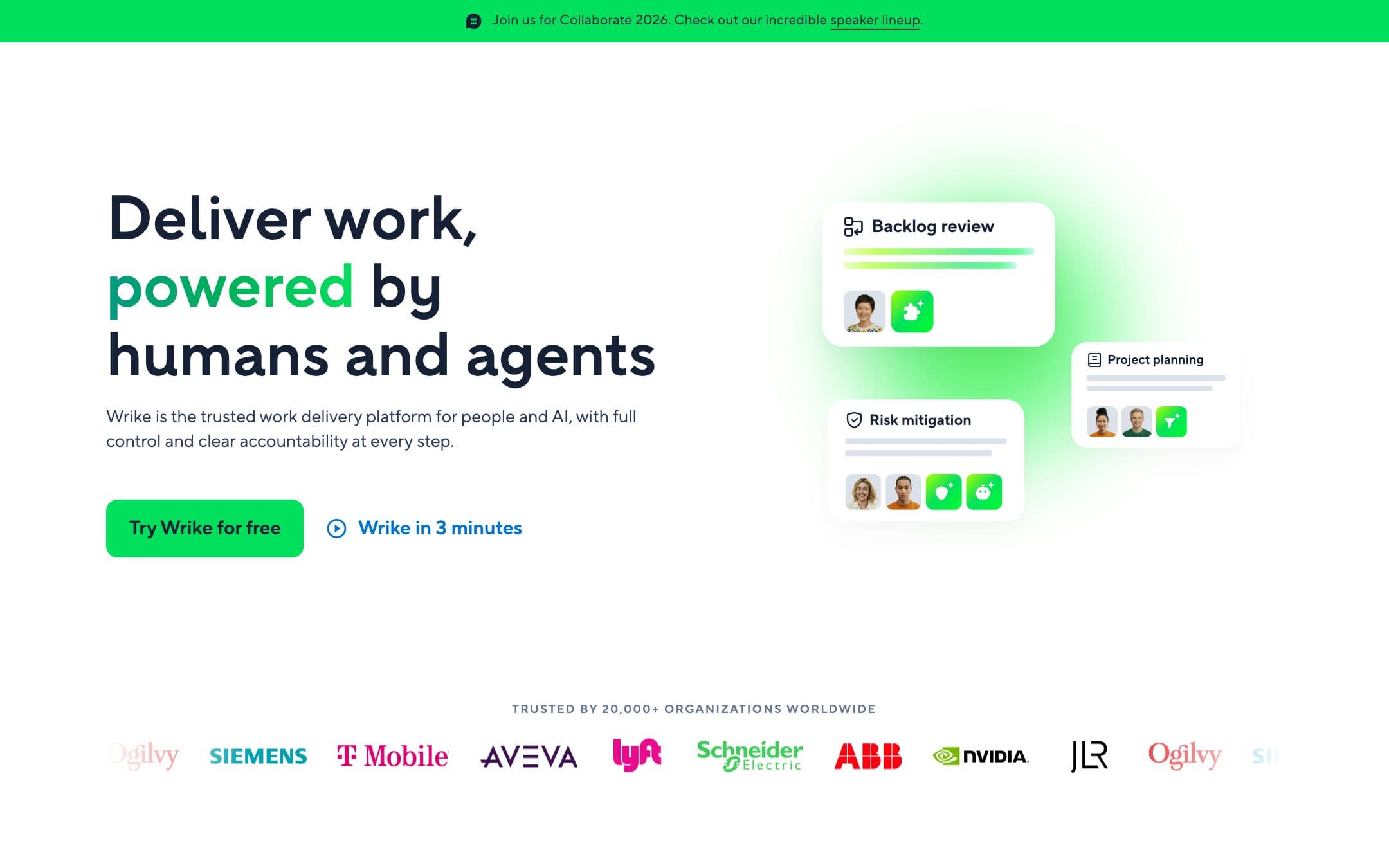
A capable tool on a plan you can outgrow
Wrike Team gives you interactive Gantt charts on the first paid tier, which monday.com and Trello do not. Above it sit proofing, approvals and real resource and capacity planning, which only Asana Advanced approaches in our comparison, and then without the proofing.
Then the plan card, in small type: 2 to 15 users.
Wrike scores 6.8 under how we rate, the lowest of the seven, and sits in the also-considered list. Not because the software is weak. Because of the shape of the plan you can afford.
Fifteen, and then twenty five dollars
Team is $10 a user a month billed annually, so $1,200 for ten people over twelve months. Business is $25 and runs from 5 to 200 users. Both are annual-billing rates: the pricing page states the amount is priced per month and billed on an annual per-user basis. Whether Team can also be bought monthly is unpublished, and the only related statement is that Business and above cannot.
Two and a half times the rate is the actual step in this ladder, and there is nothing between. Seats are sold in groups of five up to thirty, so eleven people buy fifteen. A team of ten that hires six people in a year is not paying for six more seats at $10; it is moving to $25 a seat for everybody and buying twenty of them, from $1,200 a year to $6,000.
Fifty actions a seat, and what happens at the cap
Wrike meters automation per seat rather than per account: 50 actions per paid seat per month on Team, 200 on Business, 1,500 on Pinnacle, 3,000 on Apex. For a team of ten that is 500 a month, more than monday.com Standard's 250 and half of ClickUp's 1,000.
The behaviour at the ceiling is the harshest published by anyone here. When the account reaches the limit, all rules are disabled automatically. Not throttled, not queued. Off. Admins are emailed at 50 percent and 10 percent of the threshold, which is decent warning, and it still means a process can stop working on the 23rd of the month.
The free plan has no automation rules at all, and a free account is deleted after 180 days of inactivity, which is six times the thirty days Basecamp gives a cancelled paying customer, though the two are not the same event.
The backup that is not on the plan you bought
Wrike's account backup is a genuinely good export where you can get it: tasks, folders and projects with descriptions and time logs, file attachments stored in Wrike, comments, and user information.
It is available on Business, Pinnacle and Apex. Not on Free. Not on Team. So the plan our comparison prices, the one a small team would actually buy, cannot export itself.
Three further limits worth knowing. The backup excludes the recycle bin, the activity stream, blueprints, and any file attached from Box, Dropbox or Google Drive rather than uploaded to Wrike. And Wrike states that backed up data cannot be imported back into Wrike, so it is a record rather than a restore.
The terms are the least forgiving of the seven on the way out, and they are in capitals: no refunds for partial or unused subscription periods, or where a customer has downgraded, or for a feature paid for and not used. Separately: a downgrade "may cause the loss of Customer Data or Add-ons", and Wrike disclaims liability for it.
Three owners in three years
Wrike's own about page dates it: Citrix in 2021, an independent entity in 2022, and Symphony Technology Group in 2023. That is not a criticism of the product, and private equity ownership is normal in this category. It does mean the roadmap and the price list have changed hands twice recently, and a new top tier, Apex, arrived in January 2026 above Pinnacle rather than replacing it.
SAML SSO sits on Pinnacle and Apex, the two plans with no published price, and the help centre lists it as explicitly unavailable on Free, Team and Business. Of the seven tools here, Wrike puts single sign-on furthest from a number.
One smaller thing, and it is the sort of detail that shapes a trust score. Wrike's pricing page still advertises "ISO 27001:2013" and describes the company as Privacy Shield certified, an arrangement invalidated in 2020. The trust centre is current and complete. The page selling the product is not.
Who should buy it
Buy Team if you are a project manager who wants a proper Gantt, proofing and approvals, your team is comfortably under fifteen people, and you are not counting on exporting your own data.
Buy Business if any of those is not true, and price $3,000 a year for ten people against Asana at $1,318.80 before you do.
Do not buy Team if you expect to grow past fifteen this year, because that is not a seat purchase, it is a plan migration at two and a half times the rate.
Prices, seat ranges, automation limits, backup availability, the ownership timeline and the terms on this page were read from the vendor pricing page, about page, help centre, terms of service and newsroom on . We did not test the products in this comparison.


