Skip to content
Top 4 Picks
Four picks. One of them is yours.

Asana review

The fewest caps of the seven, at the highest price among our picks.

ARecommended

The verdict

The one plan here that does not meter the things a team uses every day, and you pay for that.

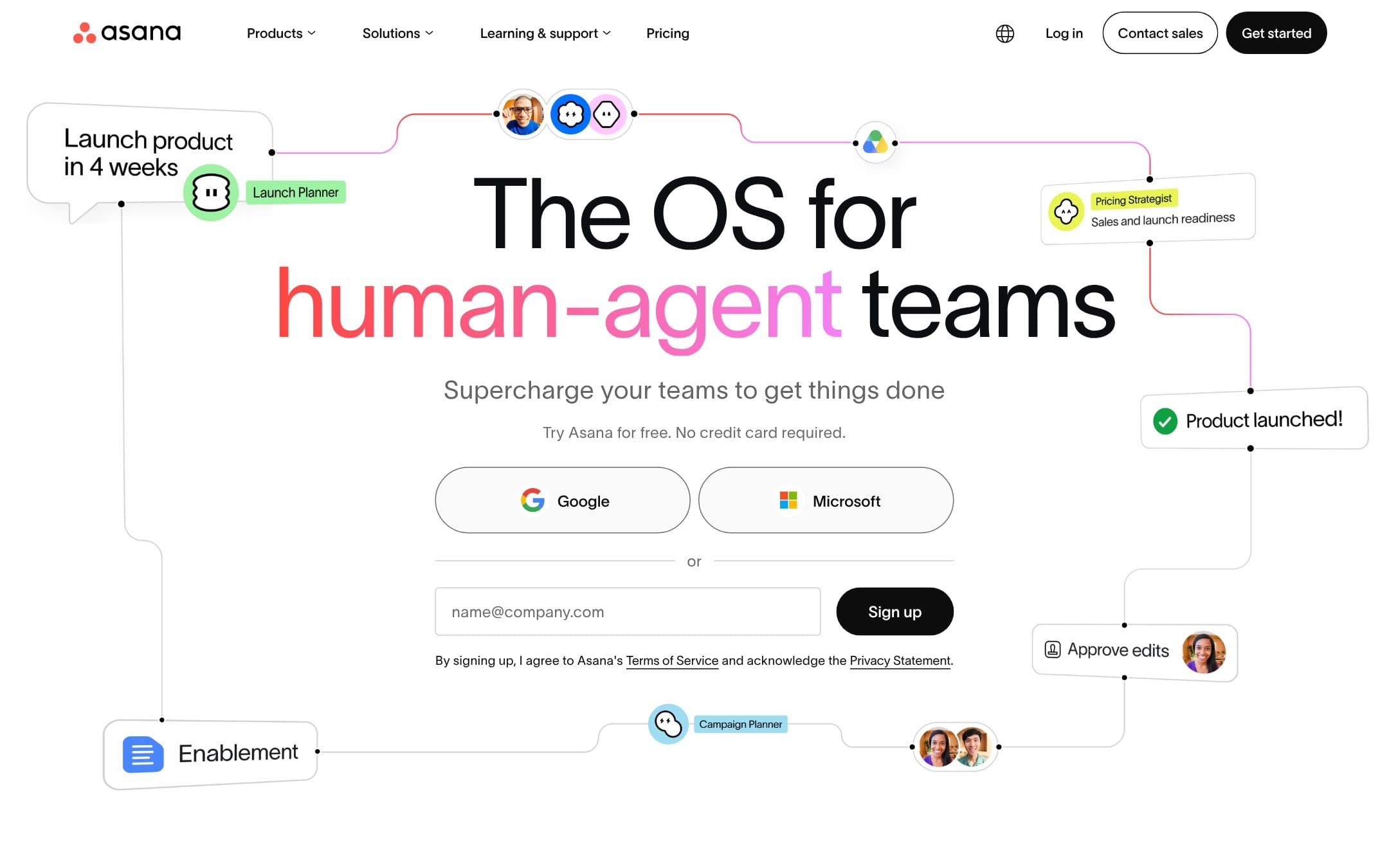
Asana homepage with the headline "The OS for human-agent teams" and a signup form, surrounded by illustrated task cards
The Asana homepage as it looked on 1 September 2026.

How the 8.3 is built

Score breakdown for asana, criteria set Software and apps
CriterionWeightScore
Capability

Timeline, Gantt, dependencies, forms and unlimited automations all sit on the first paid tier, and portfolios, goals and workload management sit one step up. The only entry plan in this comparison that does not meter something a working team needs weekly.

30%8.5
Usability

The clearest of the full-featured tools here: one way to do most things, and a task model that does not ask a new user to choose an information architecture before they can write a to-do.

20%8.5
Value

The dearest of our four picks at $1,318.80 for ten people for a year, though monday.com is dearer still at $1,440, and seats sold in blocks of five above five users, so a team of eleven pays for fifteen. What the money buys is the absence of caps.

20%7.5
Integrations

Over a hundred integrations, a documented API, and Salesforce, Tableau and Power BI on Advanced. The strongest fit with the rest of a business stack in this set.

10%9.0
Support

A large help centre, an active forum, and the only vendor here besides monday.com publishing a contractual uptime figure, though it applies to Enterprise only.

10%8.0
Trust

Listed on the NYSE with published accounts, SOC 2 Type 2, SOC 3 and five ISO certifications. Against that, the SLA and SAML SSO are both Enterprise-only on a plan whose price the vendor does not publish, and no deletion timetable exists for a closed account.

10%8.0
Weighted total100%8.3

Pros and cons

What works

  • Timeline, Gantt, unlimited automations and unlimited free guests on the first paid tier
  • Both billing cycles published, with no derived annual figure needed
  • The broadest integration set in this comparison, including Salesforce and Power BI
  • A public company with audited accounts and a full compliance set

What does not

  • The dearest of our four picks at $1,318.80 for ten people, though monday.com is dearer still
  • Seats sold in blocks of five above five users, so eleven people pay for fifteen
  • SAML SSO and the uptime SLA are both Enterprise-only, at a price Asana does not publish
  • The free plan is two seats, which is a trial rather than a team plan

What Asana costs

From $10.99 per month · free tier available

Asana pricing tiers
PlanMonthlyAnnual, per monthWhat you get
StarterPer user, smallest plan sold is two seats$13.49$10.99Timeline and Gantt on the first paid tier, which is not true of every rival here · Unlimited automations and unlimited free guests · AI Studio Basic with 50,000 credits a month for the whole billing account
AdvancedPer user$30.49$24.99Unlimited portfolios, goals, workload and approvals · Salesforce, Tableau and Power BI · 75,000 AI credits a month for the account
Personal, freeUp to 2 seats per project and team$0Two seats, which makes it a trial rather than a team plan · Unlimited tasks and projects, list, board and calendar views · No Timeline, no Gantt, no automations

Both billing cycles are printed: Starter is $10.99 a user a month billed annually or $13.49 billed monthly, Advanced $24.99 or $30.49. No annual total is published, so the twelve month figures on our pages are the annual rate twelve times, which is what the vendor charges rather than a derivation. Two structural facts matter more than the rate. Seats are sold in blocks: "Between 2 and 5 total users: add seats in increments of 1", then increments of 5 up to 30 users, 10 up to 100, 25 up to 500 and 50 above that, so a team of eleven buys fifteen seats and a thirty first user costs ten. And the free Personal plan is now two seats, not the fifteen it used to be, which turns it into a trial. Against that, Starter is the only entry paid tier in this comparison that carries Timeline, Gantt, unlimited automations and unlimited free guests at once, and Asana is explicit that guests do not affect the user count.

Key specs

Asana key specifications
PlatformsWeb, macOS, Windows, iOS, Android
API access
Team features
Data export
GDPR
SOC 2
Mobile app
Support channelsHelp centre, Community forum, Email
Uptime SLA99.9% per fiscal quarter, Enterprise and Enterprise+ only, with up to 360 minutes of quarterly maintenance excluded
What happens when you stop payingAccess to paid features ends at the end of the billing cycle, including Timeline and task dependencies. No deletion timetable is published for a closed account
Cheapest working planStarter at $10.99 a user a month billed annually
Minimum seats and incrementsSmallest plan sold is 2 seats. Increments of 1 up to 5 users, then 5 up to 30, 10 up to 100, 25 up to 500
Free guestsUnlimited free guests, stated not to affect the user count
Automation allowanceUnlimited automations from Starter
Timeline or Gantt fromStarter, the first paid tier
StorageUnlimited files, 100 MB per file on every plan
Export formatsJSON and CSV per project
What the export containsNot established. The export article does not say whether attachments or comments are included
SAML SSO fromEnterprise. Google SSO from Starter, SAML and SCIM are Enterprise and Enterprise+ only, and Enterprise pricing is not published

Who it is for

Best for

  • A team that would rather pay more than discover a cap in month three
  • Anyone whose work has to reach Salesforce, Tableau or Power BI

Not for

  • A team of eleven or twenty six, which pays for fifteen or thirty
  • Anyone who needs SAML SSO without an Enterprise conversation

In more detail

The one plan here that does not meter anything

Four of the six rivals in our comparison sell an entry paid tier with something switched off in it. monday.com withholds the timeline. ClickUp counts your uses of it. Trello does not have one until the second tier. Wrike rations your automations by the seat and turns them all off at the cap. Only Notion Plus meters nothing either, and Basecamp has nothing to meter.

Asana Starter has Timeline, Gantt, unlimited automations and unlimited free guests, and it is the first plan you can buy. That is the entire argument for the pick, and Asana charges for it.

It scores 8.3 under how we rate, the highest of the seven, and it is our Best Overall pick.

What it costs, and the blocks nobody mentions

Starter is $10.99 a user a month billed annually, or $13.49 billed monthly. Both cycles are printed, which three vendors in this set manage. For ten people over twelve months that is $1,318.80, the dearest of our four picks, though monday.com is dearer still at $1,440.

Now the part the pricing page puts in an FAQ. Seats come in blocks:

"Between 2 and 5 total users: add seats in increments of 1. Up to 30 total users: add seats in increments of 5. Up to 100 total users: add seats in increments of 10. Up to 500 total users: add seats in increments of 25. More than 500 users: add seats in increments of 50."

Asana lays that out as a bulleted list. The wording is verbatim; the full stops are ours.

A team of eleven buys fifteen seats. A thirty first person costs ten. Nobody in the category writes this down, and monday.com and Wrike do the same thing, so it is a category habit rather than an Asana quirk. It is still $527.52 a year for four seats you did not want.

The free Personal plan is two seats. It used to be fifteen, and people still recommend it as a team plan. At two, it is a trial.

Guests are genuinely free, and that is unusual

Asana's wording is unqualified: unlimited free guests, and inviting external collaborators does not affect your user count.

Compare it across the set. Trello makes single-board guests free and bills anyone who joins a second board. ClickUp gives you five guest seats plus two per additional paid user. monday.com and Wrike give unlimited free viewers who can only read. Notion matches Asana and does not count guests as seats.

For an agency running client projects, that difference is worth more than the price gap between any two plans on the page.

Where the money stops

Two things sit behind a price Asana does not publish.

SAML SSO and SCIM are Enterprise and Enterprise+ only. Google SSO arrives on Starter, which covers a lot of small teams, but if your security review asks for SAML you are in a sales conversation with no list price to anchor it.

The uptime SLA is Enterprise-only too. It promises 99.9 percent per fiscal quarter and excludes up to 360 minutes of maintenance a quarter. That is a real commitment and better than ClickUp or Wrike, who publish none at all, but you cannot buy it at $10.99.

The compliance set behind it is the strongest here: SOC 2 Type 2, SOC 3, and five ISO certifications, on a company listed on the NYSE with published accounts.

What is missing

No deletion timetable. Asana documents a 30 day restore window for deleted projects and tasks, and an inactivity policy admins can set from six months to ten years, and says nothing about what happens to a closed account. Basecamp publishes 30 days to deletion and 60 from backups. That is the standard, and Asana does not meet it.

The export is JSON and CSV per project, and the help article does not say whether attachments or comments come with it. On a page about lock-in that is a gap, and Notion's HTML export is the better answer.

Who should buy it

Buy Starter if you would rather pay $478.80 a year more than ClickUp than meter anything at all. That is the trade, stated plainly, and for most teams it is the right one.

Buy it especially if you run client or contractor work, because unlimited free guests with no seat consequence is the most generous position here, matched only by Notion.

Do not buy it if the bill is the deciding factor, where ClickUp does the same job for $840. Do not buy it if your team is eleven or twenty six people, where the seat blocks cost you four or four again. And do not plan on SAML at this price.

Prices, seat increments, guest terms and the service level addendum on this page were read from the vendor pricing page, trust centre, service levels page and help centre on . We did not test the products in this comparison.

Alternatives to Asana

Where Asana appears

Asana questions

How much is Asana for a team of ten?
Starter is $10.99 a user a month billed annually, so ten people for twelve months is $1,318.80. Billed monthly it is $13.49 a user. Asana publishes no annual total, so that figure is the annual rate twelve times. Verified on 1 September 2026.
Does Asana charge for guests?
No. Asana states that guests are unlimited and free, and that inviting external collaborators does not affect your user count. Enterprise adds controls over who may issue those invites.
Do I have to buy seats in blocks?
Above five users, yes. Asana adds seats in increments of one between two and five users, then five up to thirty, ten up to a hundred, twenty five up to five hundred and fifty above that. A team of eleven pays for fifteen.
Is Timeline on the cheapest paid plan?
Yes, and that is unusual here. Timeline and Gantt appear on Starter. At monday.com they start on the second paid tier and at ClickUp the Timeline view is metered at a hundred uses on the plan below Business.

Ready to try Asana?

The fewest caps of the seven, at the highest price among our picks.

Sources