

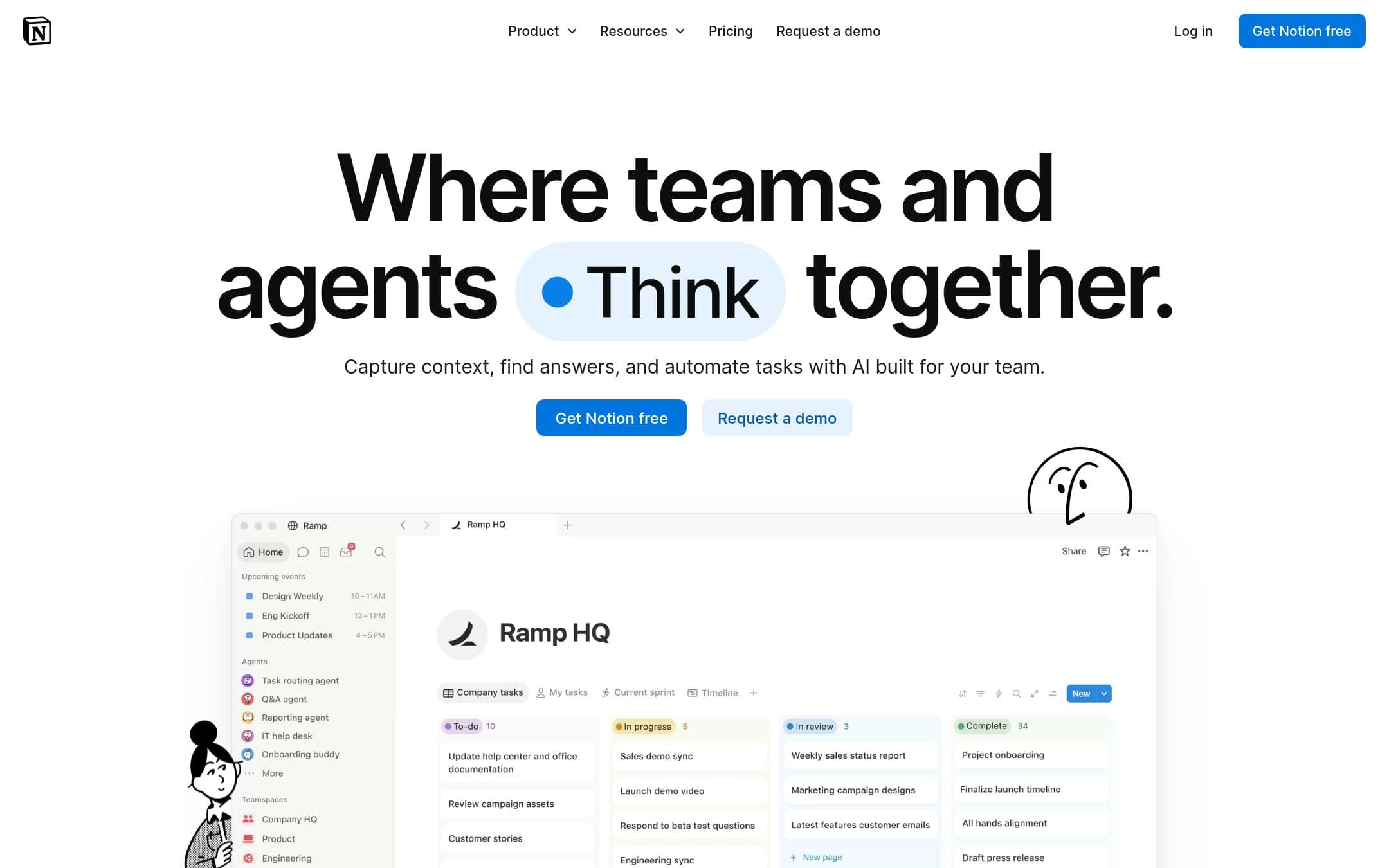
A workspace with database views, not a project manager
Notion will run your projects, and it will do it by giving you a database and asking you to shape it. That is either the appeal or the objection, and which one depends entirely on whether your projects are mostly documents.
For a team writing specs, briefs and notes and tracking the work attached to them, having one place rather than two is worth real money. For a team scheduling people across a quarter, the views do not exist: no resource management, no workload, no critical path.
It scores 7.3 under how we rate in our comparison and sits in the also-considered list for that reason rather than for anything it does badly.
What twelve months costs, and what the page will not print
Plus is $10 a member a month, which is $1,200 for ten people over a year.
Two caveats on that figure. The pricing page has a monthly and yearly toggle and, on a page served to the United States, only the yearly side is printed in the copy: $0, $10 and $20 are the only plan prices a reader sees. The monthly rates and the annual totals are in the page's own structured data, where Plus is $12 a month or $120 a year and Business $24 or $240, which is the same place monday.com hides its monthly rates. And read from Europe the same page prints euros, so a comparison shopper outside the United States cannot line Notion up against anything else here without converting.
The free plan ceiling, and why deleting does not help
The free plan is unlimited for one person. For a workspace with two or more owners it is 1,000 blocks, and the counting rule is the part people miss:
"We count blocks based on the amount of content created in your workspace since signing up"
and, in the same article:
"deleting blocks, or emptying the trash, will not reduce your block count."
You keep reading and editing what exists, you cannot add anything new, and Notion gives a three day grace period at the ceiling. It is a fair design and it is not a plan a team can sit on the way Trello free is.
The uptime promise that stops on Friday
Notion's security page says it "offers a guaranteed uptime of 99.9%". The service level terms it links to say something narrower:
"The Services shall be available 99.9%, measured monthly, excluding holidays and weekends and scheduled maintenance."
A Saturday outage is contractually not downtime. The remedy, where downtime does count, is a 5 percent credit per 30 or more consecutive minutes, and you forfeit it unless you notify Notion in writing within 72 hours.
Set beside the field, that is better than ClickUp, which publishes no figure at all, and than Wrike, whose 99.9 percent is a site footer rather than a term, and weaker than monday.com, whose Enterprise agreement runs seven days a week with a real credit schedule. The terms also never say which Notion plans they apply to.
The two things it does better than anyone here
SAML at twenty dollars. Notion Business is the cheapest SAML SSO here that comes inside a plan price. Asana, monday.com, ClickUp and Wrike all put it behind a plan whose price they do not publish, and Basecamp does not offer it at all. Trello is cheaper in total at $14, Premium plus Atlassian Guard, and only by buying a second subscription. If your security review asks for SAML and you want one line on the invoice, this is the answer.
The export. HTML export carries page and block comments, resolved and unresolved, along with the images and assets, in a zip. Trello's CSV drops comments entirely and ClickUp exports attachments as links. On a page about what it costs to leave, Notion's is the best exit of the seven after Basecamp.
Guests are unlimited on paid plans and never count as paid seats, which matches Asana and beats everyone else.
Who should buy it
Buy Plus if your projects are made of documents and you are currently paying for two tools. One subscription instead of two is the whole case and it is a good one.
Buy Business if you need SAML in one subscription, because $20 a member is the cheapest route to that here.
Do not buy it if you need to schedule people rather than tasks. Do not treat the free plan as a team plan, because the block ceiling counts everything you have ever made. And if a weekend outage would be a contractual problem for you, read the service level terms before you sign rather than after.
Prices, the block limit, the downgrade behaviour, the export contents and the service level terms on this page were read from the vendor pricing page, security page, help centre and service level document on . We did not test the products in this comparison.


