
ClickMagick tells the ad platforms what actually sold
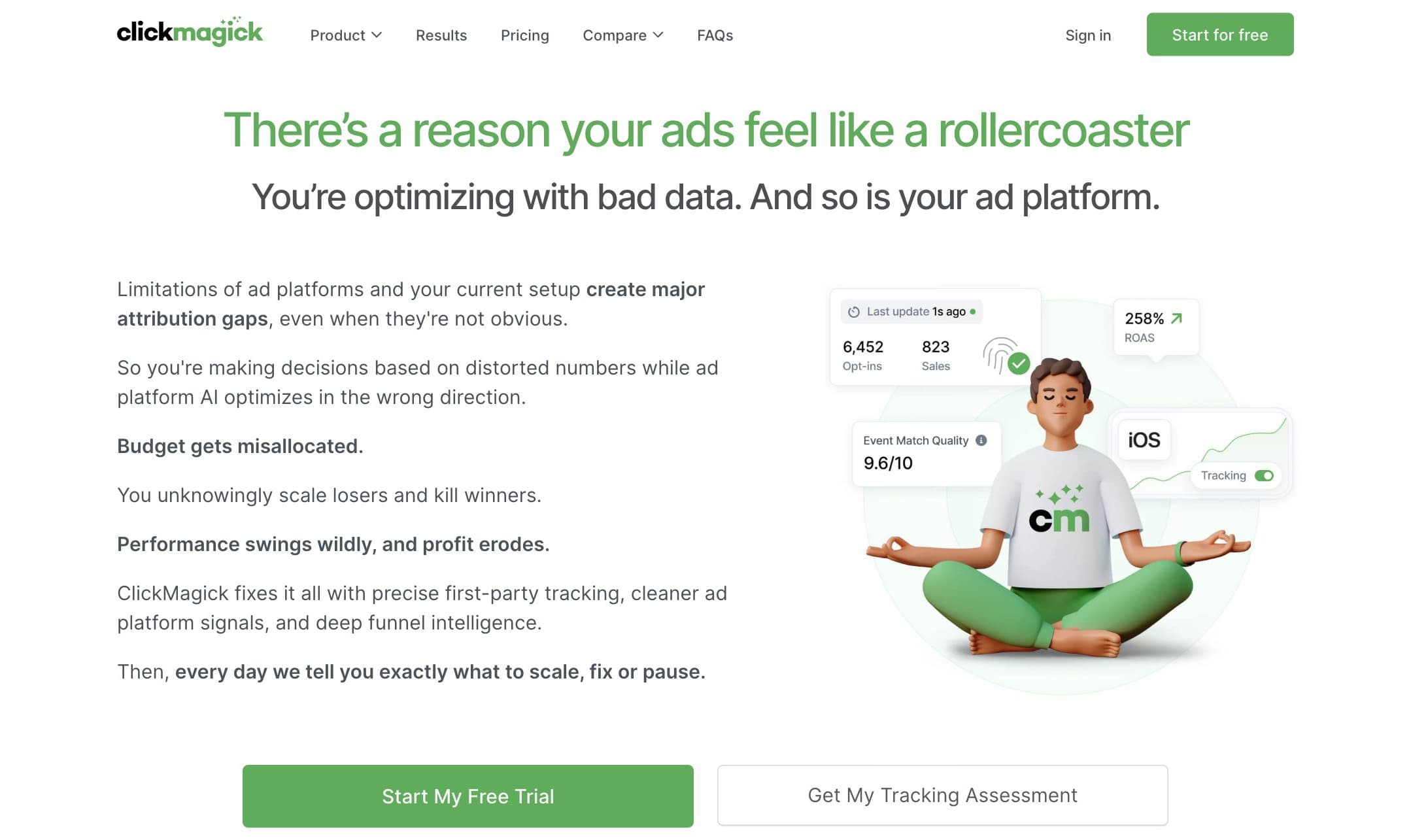
ClickMagick is ad tracking for people who no longer believe the number in Ads Manager. It puts its own tracking code on your domain, follows a visitor from the ad click to the sale, and sends that sale back to Meta, Google and five other ad platforms so their bidding works from your real conversions rather than their estimate.
That last part is the reason most buyers come. Since browsers and phones started blocking third-party tracking, the ad platforms see fewer of the sales they caused, and their algorithms optimise for the wrong people. ClickMagick's tracking runs on your own domain with first-party cookies and no redirects, which is the standard fix, and it has been doing link and ad tracking since 2014.
ClickMagick scores 8.0 under how we rate and is the overall pick in our ad tracking software ranking. The tracking and the support carry it. The plan you actually need is more expensive than the one on the banner.
The plan that fits is usually Standard, not Starter
Starter costs $79 a month and includes the core of the product: the tracking domain, the conversions API connection, automatic ad cost import, real-time reports and the mobile app. For a single affiliate running one campaign, it is enough.
For almost anyone else, three limits push you up a plan.
Starter tracks 10,000 visitors a month and keeps six months of data. It has one user and one ad account per platform. And it has basic bot filtering only. The bot and click fraud protection, the multi-touch attribution models (linear, position-based and time decay) and phone and offline sales tracking all start on Standard at $199 a month.
Standard also raises the cap to 100,000 visitors, adds two team members and a year of data, and includes a one-on-one onboarding call. For most buyers it is the plan the rest of this review is about.
Pro, at $349 a month, is for agencies and high-volume buyers: a million visitors, unlimited team members and unlimited ad accounts. The pricing page does not say how long Pro keeps your data, which is the one gap in an otherwise complete table.
Paying for a year costs ten months on every plan: $790, $1,990 or $3,490. There is no annual lock-in beyond that choice, and the monthly price needs no sales call.
Priced by visitors, with no price for going over
Every plan is sized by tracked visitors a month. What happens when a launch sends more than your plan allows is not published. There is no overage rate on the pricing page, and the Pro column ends with the question "More than 1M visitors /mo?" and no answer.
The fair use policy fills in a little. It covers customers who generate exceptionally high load over a sustained period, says ClickMagick is not meant to run an ad network or affiliate network, rules out large volumes of low-quality traffic such as pop-ups, and lets ClickMagick close an account that does not reply within seven days. Occasional legitimate spikes are excluded.
None of that is unreasonable. It is simply not a price. If a launch will double your traffic, ask support before it goes live.
Thirty days to get your money back, once
The trial is 14 days and is open to anyone who has not had a ClickMagick account in the past six months. On top of it sits a no-questions-asked 30-day money-back guarantee for new customers.
Two conditions matter. Charges older than 30 days are never refunded, and only the first account you create qualifies. So the guarantee covers the first month, not a renewal you forgot about.
If you leave, ClickMagick deletes your account data within 30 days. Export what you want to keep before you cancel.
The privacy policy names ClickMagick as the processor and offers a data processing addendum, which is what an EU business needs. It also says personal data may be transferred to ClickMagick's servers anywhere in the world, without naming a region, and its California section still carries a template placeholder where a contact email should be.
Against Hyros, the difference is a price you can read
The tool ClickMagick is most often weighed against is Hyros, and the contrast is less about tracking than about buying. ClickMagick publishes every price and bills month to month. Hyros quotes one plan on a sales call, prices it on the revenue it tracks, and runs a term that renews unless you cancel 30 days before it ends.
What Hyros adds for that is a setup team, an AI analyst and a written guarantee of better ad ROI. For a business spending heavily on ads to sell high-ticket offers, that can be worth it. Our ClickMagick vs Hyros comparison sets the two side by side, and the ClickMagick alternatives cover the rest of the field.
Who should buy it
Buy ClickMagick if you run paid traffic to your own funnel, store or affiliate offers and want the ad platforms to optimise on your real sales. Budget for Standard, because the fraud protection and attribution models are the point, and use the trial on a live campaign rather than a test page.
Skip it if you send more than a million visitors a month and need a fixed price before you start, or if you run a Shopify brand that wants margins, inventory and marketing mix modelling in the same dashboard. Tools built around ecommerce do that better.
Prices, plan limits, trial, refund, fair use and privacy terms on this page were read from the ClickMagick pricing page and policies on . We did not run campaigns through it and publish no tracking accuracy figures.